
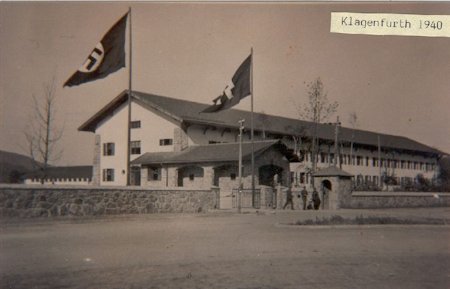
Photo of the Klagenfurt barracks in Austria.
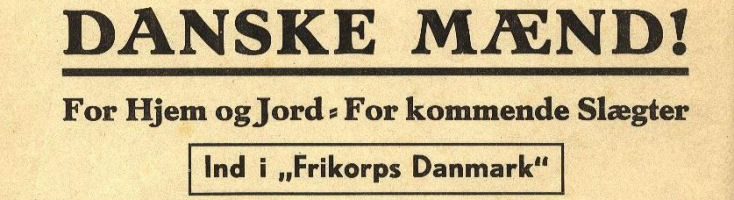
The formation of Frikorps Danmark. On 26 June 1941, the Danish government broke off diplomatic relations with the Soviet Union, and already on 27 and 28 June the first calls for the recruitment of Danish volunteers followed.
The liaison officer at the German legation, Freiherr Löw von und zu Steinfurth, writes about this: “When the German–Russian war began on 21 June 1941, Envoy von Renthe-Fink was instructed by the German Foreign Minister von Ribbentrop to make the Danish government understand that Germany’s struggle against Russia was in reality a defence of Europe against Bolshevism: ‘When the states friendly to Germany, and Denmark is considered one of these, do not themselves wish to take part in this defensive war against Russia, they should at least demonstrate their goodwill towards Germany by not only allowing volunteers to enlist for participation in this anti-Bolshevist war, but also by officially expressing that such participation is desirable, and that these volunteers, through their participation, serve the interests of their fatherland.’ Renthe-Fink presented this to Stauning and the then State Secretary Scavenius, with the implication that only states which had shown their goodwill in this manner could expect to retain their own military organisation in a Europe under German leadership.”
The then Minister of War, the Venstre politician Søren Brorsen, issued on 8 July 1941 a recruitment directive to all service offices in the country, which allowed exemption from service in the Danish Army when the purpose was to join as a volunteer in the German Army. This was a permission issued in writing by the government’s spokesperson and simultaneously functioned as a recruitment directive. The Danish government also issued authorization and approved that Lieutenant Colonel of Artillery Christian Peder Kryssing take command of an independent Danish unit under the Waffen-SS. This unit was named “Frikorps Danmark.”
The recruitment for “Frikorps Danmark” was organized by DNSAP, which through its local party offices had a wide presence across the country. However, the actual enlistment was controlled by the organization (the staff office) behind Frikorps Danmark and the German Ergänzungsamt Nebenstelle Nordsee in Copenhagen.
Danish military personnel—particularly the Danish officers—were officially granted permission to leave the Danish Army without hindrance and to enter the Waffen-SS in Germany. At the same time, they were allowed to retain their accrued rank and pension, and were assured that they could re-enter the Danish Army with full seniority upon returning home. By joining, including service in “Frikorps Danmark,” and signing a service contract, the Danish volunteers received a salary from the German Waffen-SS. This was a considerable amount, which for many became a decisive factor in enlisting. Several were thereby able to support their families in Denmark. Recruitment took place across the country through DNSAP’s local offices and was communicated to the Danish population via radio, newspapers, recruitment pamphlets, and posters.
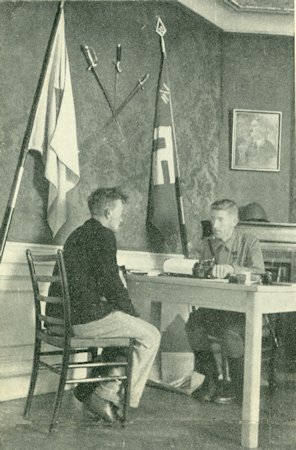
Photo of Robert L. Hansen at the recruitment office.
Not only was recruitment permitted, but the Danish government also engaged in direct recruitment of soldiers for service in the German army. The document states: “Volunteers who participate serve the interests of their fatherland.” Recruitment of Danish volunteers continued even after the dissolution of Frikorps Danmark, and although the method did not change, over time a tightening of policy occurred and other factors came into play. A strong anti-Russian and anti-Jewish campaign combined with a more German-national orientation came to characterize recruitment. The Danish Ministry of War, and thus the government, again in June 1943 issued an appeal to Danish officers to enlist. Such an appeal from the ministry to Danish military personnel was widely perceived by the Danish population as recognition and as an official endorsement of enlistment.
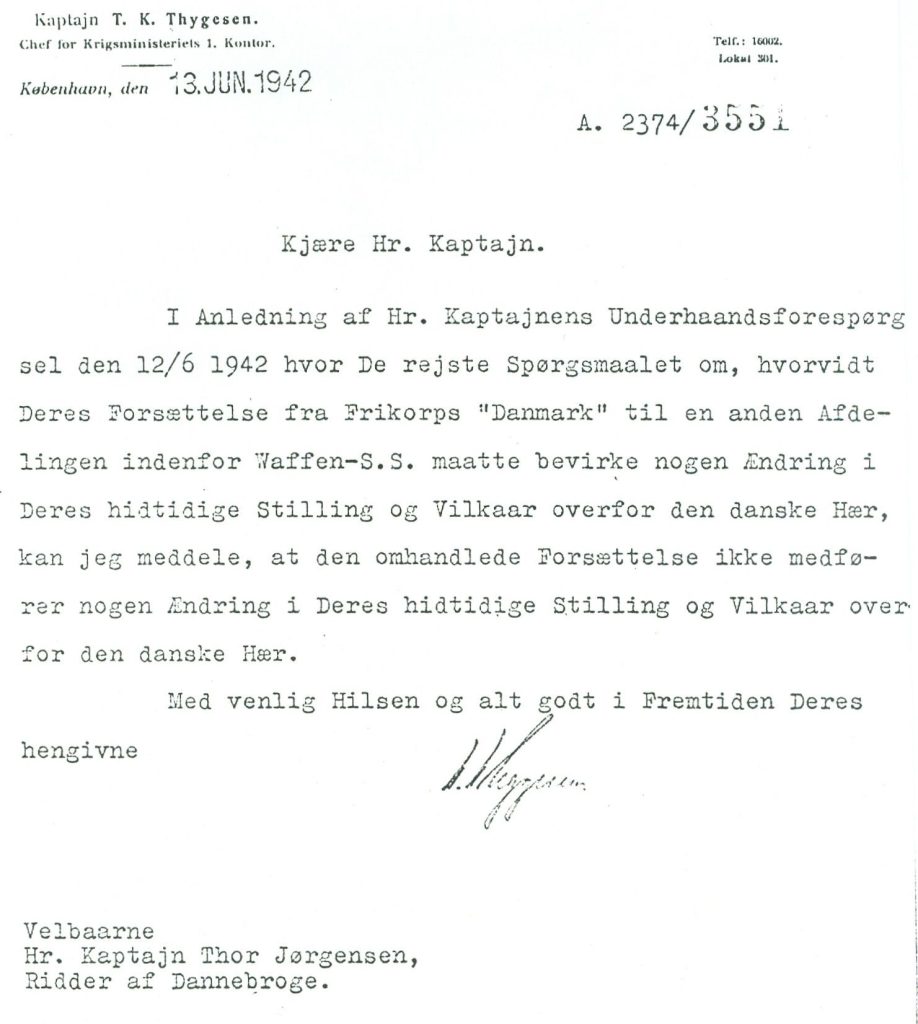
Letter from the Ministry of War.
Dated 1 June 1943. The meaning of the word “goodwill” was widely debated during the post-war legal proceedings, and due to the changed circumstances it was argued that the term could not be equated with an “official appeal.” Whether the ordinary individual who enlisted could have fully understood the implications is a matter of interpretation. Envoy and Minister Mohr used the same formulation when, on 29 July 1943, with the backing of the Danish government, he travelled to the Grafenwöhr training area to meet the Danish volunteers. He had been tasked with persuading those members of Frikorps Danmark who did not wish to be transferred into German service in a newly formed unit (Regiment 24 “Danmark”) to continue their military service, even though it was no longer an independent Danish formation.
Mohr stated: “You have volunteered to fight against the common enemy, Bolshevism, and you have already demonstrated your bravery. You serve our common fatherland best by continuing to fight until victory.”
A Danish officer has expressed his reasons for enlisting in the following way:
It became increasingly clear to us that we had made the right choice. We rejoiced when we heard that the Danish government had broken off relations with Soviet Russia. Bolshevism, which the year before had attempted to crush our brother nation—Finland—and would then undoubtedly have sought to seize all of Scandinavia and dominance in the Baltic Sea.
The events led to the creation of Frikorps Danmark, which the King and the Government recognized as a Danish corps, and anyone must be able to understand the feelings of the Danish volunteers when we were allowed to fight under the Danish flag. The most important thing for us volunteers fighting at the front is to feel that our homeland understands our struggle and stands behind us. We were therefore deeply grateful to the King, the Danish Government, and the authorities for the recognition of the Frikorps and for the permission to fight under our own national flag. We also received renewed support when Denmark, in the autumn while the fighting in Russia was still ongoing, joined the Anti-Comintern Pact.
Our faith in the struggle gained perhaps its greatest strength when we in Russia saw what it was we were fighting against. When we became acquainted with the enormous build-up that had been carried out on the other side of the Russian border against all European countries, we understood how strongly our own homeland had also been threatened. The greater the horrors we encountered, the greater the poverty and misery we saw at the front, the more certain we became of our cause. It was the Bolsheviks’ own brutal cruelty and bestial way of warfare that made us shout hurrah when we attacked. Our own mistreated comrades… I myself could not, even in my wildest imagination, have believed that human beings could be so evil and depraved.
Director of the Ministry of Foreign Affairs, Nils Svenningsen, wrote in an article after the war: “The sincere desire of the Danish government throughout the war was to cooperate, as it was the only possibility of bringing Denmark through the war unscathed. The resistance movement made it difficult for the Danish government to carry out cooperation with the Germans.”
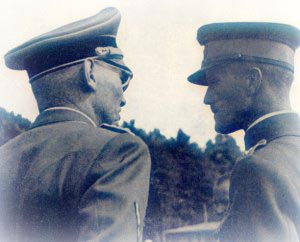
From a recruitment meeting in Klerkegade in Copenhagen, Lieutenant Colonel C.P. Kryssing (right) in conversation with SS Police General and Brigade Commander Kanstein.
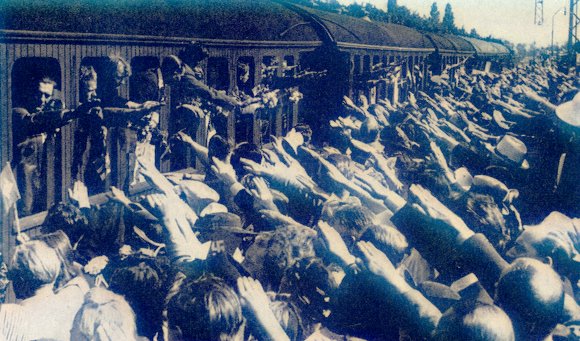
Photo from the departure on July 17, 1941 from Hellerup freight station.
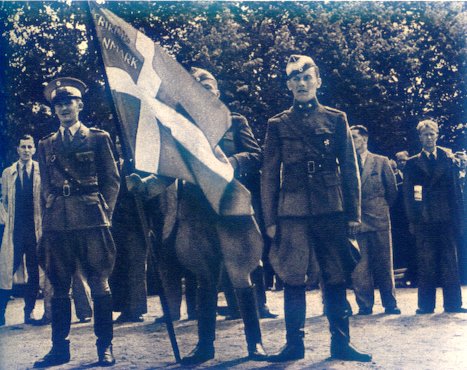
Photo of some of the Danish officers who participated in the departure.