
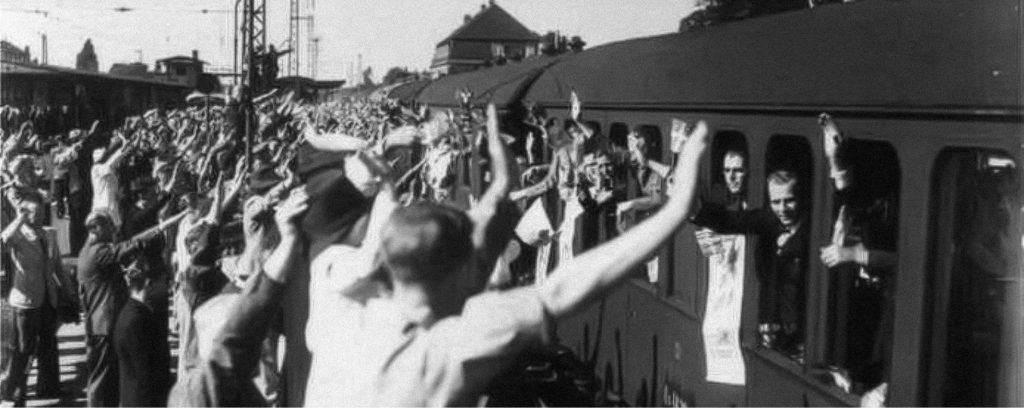
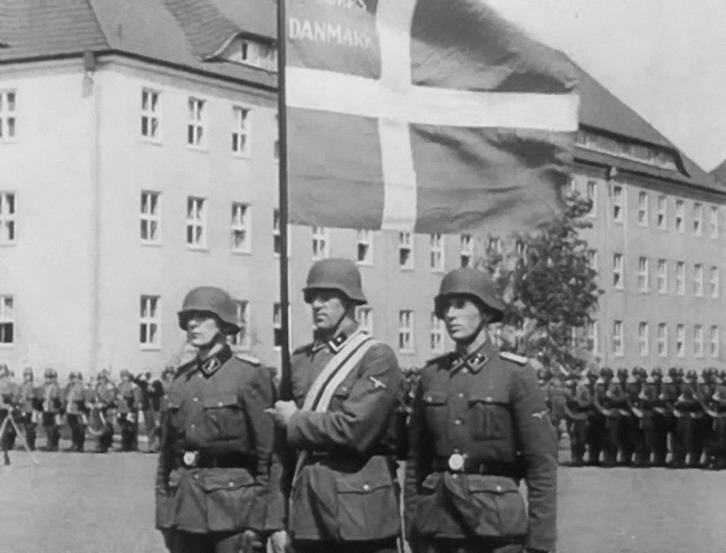
The first contingent of Danish volunteers departed amid a large farewell ceremony from Hellerup station on 19 July 1941 and arrived as scheduled at Hamburg railway station in the afternoon, where they were received by a military band and a larger reception committee. The incoming soldiers were accommodated at the SS “Germania” barracks in Hamburg-Langenhorn, and shortly afterwards approximately 300 Danes arrived from the preparatory school in Sennheim (where instruction included political matters as well as sports). At the Hamburg barracks there was no direct training ground, so training mainly consisted of theoretical instruction and drill exercises. During this period, catastrophic political changes occurred, and Danish national demands such as the use of the Danish language and Danish officers were obstructed by the German side, on the grounds that this had not been specifically agreed for the unit.
The Free Corps was relocated to actual military training on 13 September 1941, when it was transported by train via Berlin to the Treskau training area near Posen in Poland, to a large barracks complex with its own troop training grounds. Part of the personnel was billeted in buildings that had previously been a monastery. Frikorps Danmark’s companies arrived as follows: 13 September: HQ + 1st Company; 14 September: 2nd + 3rd Company; 15 September: 4th + 5th Company.
The unit began a training program in accordance with the regulations prescribed by the Danish staff, but political pressure and a possible professional issue (lack of formal military training among the Danish officers) led to the partial imposition of German officers, German command language, a change to a German command structure, and the replacement of the Danish-minded commander Kryssing with the staunch National Socialist C. F. von Schalburg.
The corps completed its military training and was declared combat ready. On 7 May 1942, the four companies were transported by train from Treskau to the airfield at Heiligenbeil, approximately 45 km southwest of Königsberg, in order to be flown to Demyansk in Russia, where they were to be deployed at the front line. The flight involved a stopover and transfer to JU52 front-line aircraft at an airfield in DNO. The heavy support unit (“Trosset”) had to travel by freight train via Lithuania and Latvia and arrived much later in the area.