
The triskel on the collar tab (also called trifos) originates from the early period in Hamburg-Langenhorn. In the camp, a joint European unit called “Standarte Nordwest” had been established, consisting of Walloons, Flemish, and Danes.
The unit was dissolved again in September 1941, as the nations requested independent national formations. The SS Main Office (SS-Führungshauptamt), through the RZM, had ordered the production of collar tabs featuring a three-armed sun wheel (symbolizing the three participating nations) for the unit. These were stored in the clothing depot when the Free Corps arrived at the camp.
Neither the Danish nor the German side wished for an independent Danish national unit to wear SS runes, and therefore the existing collar tabs with the triskel were used. However, these were ordered removed after a short time in Treskau. With the arrival of the German training staff, they were replaced with standard Waffen-SS collar tabs bearing SS runes.
The Dannebrog on collar tabs is known in several types, of which Type 1 can be regarded as the official version.
Type 1: It is believed to have been produced in Denmark on the order of former Danish captain, later holding the rank of Hstuf. Kaj Islin Hansen, and introduced at the Ersatz Company in Brobruisk. This was contrary to German regulations and was therefore ordered removed when the volunteers were sent to frontline service or to Treskau, respectively Graz. It was manufactured in black felt with a chain-stitch embroidered Dannebrog, a backing of heavy light-grey cardboard, and attached with crossed black stitching thread.
Type 2: black felt with a Dannebrog sewn on in the form of red flag fabric and a 3 mm white ribbon forming the cross. The reverse side is made of coarse greyish stiffened canvas. It may have been produced by DNSAP women’s groups.
In addition, there also appear to be a few privately made versions that vary in the size and design of the Dannebrog. A so-called prototype from the RZM is shown in some books, but it is not documented as having been put into production or worn. It is believed to be a draft from the period in 1941 when the SS-Führungshauptamt was still considering approval of an independent Danish national unit.
Similar national symbols on collar tabs are known from, among others, the Norwegian, Estonian, and Latvian legions.
In terms of production, reference is often made to the “RZM”.
RZM: (Reichszeugmeisterei) The NSDAP established, as early as 1933 at its headquarters in Munich, a system of quality control and standardization for all badges, decorations, uniforms, and related items. Any company wishing to produce party or military items had to be approved by the RZM and comply with its specifications, including quality requirements. The items are often marked with “RZM”.
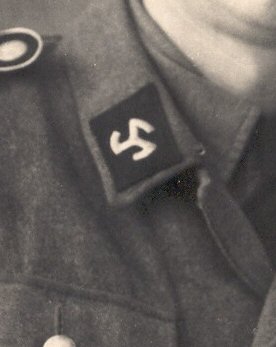

For Danish volunteers who arrived at the former Germanic barracks in Hamburg-Langenhorn, the triskel (also called the trident) became the first symbol worn. Previously, during pre-training in places such as Sennheim, they wore no collar tabs or completely plain ones (i.e., plain black).
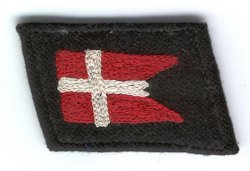
The strong desire to display nationality led to the creation of collar tabs featuring national flags. In the case of the Danes, these were produced in Denmark (at the initiative of the party) and sent to the replacement company (recruit company), so that nationality could be displayed until they were assigned and formally incorporated into the Waffen-SS, where they would receive collar tabs with SS runes.

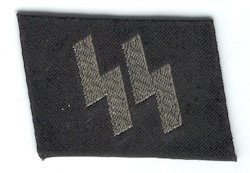
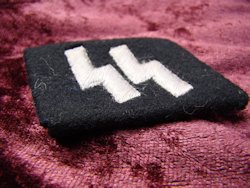
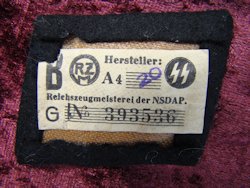
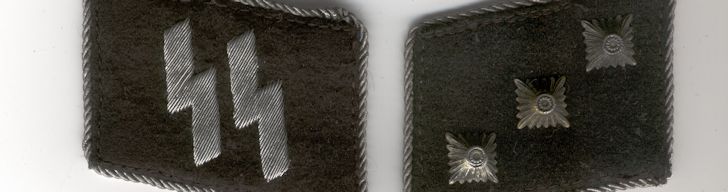
After being accepted into the Waffen-SS, it was permitted to wear the standard SS collar tabs.

When a new 11th Panzergrenadier Division “Nordland” was created in April 1943, a new collar tab design was introduced – the sun wheel. This should not be confused with the more vertical and horizontal type worn by the Schalburg Corps in Denmark.


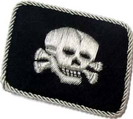
For other units in the SS, collar patches were designed with other information, such as SS2 = Germania. Several of these collar patches exist in Denmark, as the Schalburg Corps was sent St. Germania’s old uniforms for use by the Corps in Denmark. “Death’s head” for the Totenkopf unit, not to be confused with the smaller death’s head (often metal) worn by armored units.