



The Frikorps staff learned of this and, via the Ergänzungsamt in Copenhagen, initiated production of a sleeve band with the text “Freikorps Danmark.” In appearance, it was similar to the RZM-standardised type, but the Danish-produced version was made with Gothic script woven into a thin black silk band (Type I). Note the mixed German–Danish terminology.
The band was produced by the company Alf Berg in Copenhagen on order from DNSAP and based on a design draft by Lieutenant H.K.P. Nordholm. Shortly afterwards, after the Danish-produced stripe had already been sewn on, the Free Corps received the official RZM version.
Nordholm, the leading figure, was killed on the Eastern Front as one of the first on 23 May 1942, and since the party was simultaneously in political turmoil and partly losing its function as the Danish recruiting authority, payment to Alf Berg was withheld, and he unsuccessfully attempted to bring legal action against DNSAP.
Type 2 stripe was produced in Germany according to standard RZM regulations, in a black woven cotton band with the Latin inscription “Freikorps Danmark” in white cotton thread.
Upon the disbandment in April 1943, the “Freikorps Danmark” sleeve stripe was approved as a tradition sleeve stripe and could be worn together with the unit sleeve stripe for the new Regiment 24 “Danmark”, bearing the text “Danmark”. Permission to wear both stripes was to be recorded in the individual’s military service papers (Soldbuch).

Free Corps stripe in RZM type and silver-thread officers’ version.


Upon the transition to the 11th Panzergrenadier Division, Regiment 24 “Danmark” was assigned new unit sleeve stripes.











The German army had used sleeve stripes for a long time, and during the Third Reich they served multiple functions. They could be awarded as a decoration on the same level as a medal, such as the Crete or Africa cuff titles. They could indicate the wearer’s function, such as the field post or military police stripe, or they could show affiliation to a specific unit, such as the Afrika Korps or Großdeutschland.
Within the SS, and especially the Waffen-SS, sleeve stripes reached their greatest extent of use. Almost everyone was issued sleeve stripes indicating their unit affiliation, most often a regiment or a division. It was only toward the end of the war that a decline in the use of sleeve stripes could be observed.
When Frikorps Danmark was established, only one main type of sleeve stripe was generally used within the Waffen-SS: the RZM type. This early type is characterized by a “silver” (aluminium) edging and machine-embroidered text in grey/white cotton for enlisted men. For officers, the text was hand-embroidered in “silver” (aluminium), although it is assumed that clear documentation for this is lacking.
The text on the stripe became a Danish/German compromise: “Freikorps Danmark.” The most common Frikorps Danmark sleeve stripe is the enlisted-men version of the RZM type; it also exists as a hand-embroidered officers’ version.
To save Reichsmarks, hand embroidery was replaced by weaving the text directly into the band. This type is called flat-wire woven or flat-woven RZM. FD stripes of this type exist for officers with “silver” or celluloid-thread edging. A distinctive feature of this type is that a protective fabric is sewn over the text on the reverse side.
There is a special FD sleeve stripe. This stripe differs significantly from other types simply because it was manufactured in Denmark and therefore outside RZM control. The stripe resembles more a naval cap tally, but can also be compared to the Schalburg sleeve stripes, which were likewise produced in the country. The text on this stripe is in Gothic script, and it exists only for enlisted personnel.
The most widespread types of sleeve stripes from the war years are the BeVo and BeVo-like types. BeVo is short for Bandfabrik Ewald Vorsteher. BeVo stripes are characterized by the fact that, at one end, the text “BeVo Wuppertal” is woven into the fabric. Another clear difference between a BeVo and a BeVo-like stripe is that the edging on a BeVo stripe is woven perpendicular to the length of the band, whereas on BeVo-like stripes the edging is woven along the length, as on the RZM types.
The most widely used sleeve stripe types from the war years were the BeVo and BeVo-like types. BeVo is short for Bandfabrik Ewald Vorsteher. BeVo stripes are characterized by the inscription “BeVo Wuppertal” woven into one end. Another clear difference between BeVo and BeVo-like stripes is that the edging on BeVo stripes is woven across the length of the band, whereas on BeVo-like stripes it is woven along the length, as in the RZM types.
It should also be noted that several of the volunteers in Regiment 24 “Danmark” wore a Frikorps Danmark sleeve stripe, having simply cut away the “Freikorps” part. This was not solely due to reuse, but more likely because the Frikorps Danmark stripe had more “shine” in the form of “silver” edging, which had been omitted from the “Danmark” stripe.
(*): RZM is short for Reichszeugmeisterei. The RZM was an approval and control authority for all uniform equipment, such as buttons, shoulder straps, belt buckles, and of course sleeve stripes produced for the state in the Third Reich. The control of sleeve stripes included, among other things, attaching labels with production data to the items, so that the responsible manufacturer could always be traced. This applied both to the weaving of the band itself and to the embroidery of the text. Therefore, if the weaving and the embroidery were not carried out by the same manufacturer, the stripe would carry two labels, as is the case with the Frikorps Danmark stripe.
Text prepared by P. Christensen.
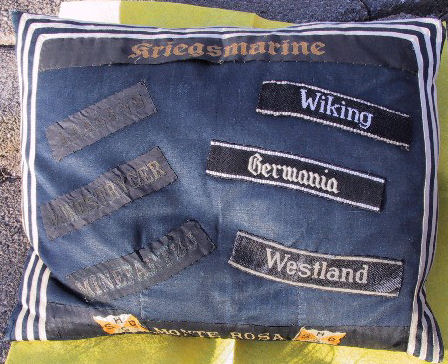
P. E. Andersen from Snekkersten had kept his sleeve stripes all the way back from his time in the Danish Navy. Sometime in the 1960s, his mother found them and made a cushion from his naval jacket, onto which she sewed the various sleeve stripes her son had worn.