
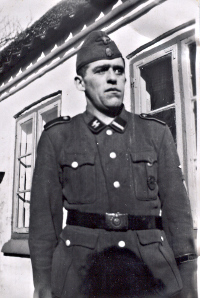

Summer 1941 to present date
When the war against Russia began, there was a call to former Danish soldiers to enlist for the front. The Minister of Defence, Alsing Andersen, urged the conservative Colonel Kryssing and his adjutant Thor Jørgensen from Holbæk to lead “Frikorps Danmark.”
I, like others, received written permission from the ministry and went for training in Hamburg and later in Poland.
Deployed in the war in May 1942. I was wounded on 23-02-1943 in the head (80% disabled). I remained in hospital until 15-09-1943 and was in a medical company for the rest of the war. On 05-05-1945 I was imprisoned together with many others. I received a 3-year prison sentence and was held in Ringsted, Roskilde, and Horserød.
Released in May 1947 and started working again from the ground up, doing the poorest jobs, but have managed to support myself without being a burden to society (once again: 80% disabled!).
When Germany had begun to recover after the war, the German Red Cross granted aid to wounded soldiers with a disability from 50%, which I have received since 1972. These funds are tax-free in Germany according to the attached document.
As for the Danish resistance fighters (joke aside): how has the population viewed defeated Germany, which has now risen again as a wealthy state? Denmark got through the war very lightly compared to Norway, the Netherlands, Belgium, England, and France. Despite this, Denmark has remained a poor country and has borrowed a great deal of money both from Germany and from other wartime powers. Why has Foreign Minister Munk’s diary been classified until 1998?