
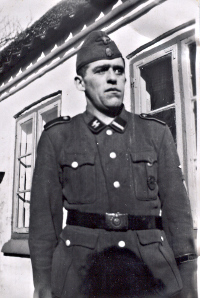

The last 4 months of the war became a major wave of explosions and murders from both sides (terror against terror) also here in Denmark, and many compatriots ended up in German concentration camps in Germany. On 20 April 1945, on the German Führer’s birthday, I was promoted to Unterscharführer, which however did not last long, as the capitulation came on 5 May.
The war in Europe was now over, and many people could once again begin to breathe normally; but fate willed it otherwise. A wave of terror arose across all of Europe against National Socialism and against people who had directly or indirectly fought against Germany’s enemies.
My wife, together with several friends and comrades, was imprisoned in Køge. On the way there they were spat at and insulted by the neighbours. In Køge, at the time of being unloaded, the same thing was repeated by the townspeople, and my wife stayed there for 9 weeks, while my father was held there for 8 days.
On 7 May we, who were soldiers here in Ringsted, were disarmed by a horde and band of thieves who called themselves resistance fighters. We were then locked up in the barracks’ gun house, where I have written this book. During the first month we had these “freedom fighters” guarding us; they stole all our clothes, money, watches, and my bicycle.
After them came the Swedish Brigade, which was no better than the others. We were 200 internees here, and the first thing they did was to place a coffin out in the corridor. Violence and terror against us were part of everyday life. Several were hit by gunfire; all movement took place at a run.
In the presence of the police, several people were pulled out and severely beaten by civilians who had no business being there. Many stood with their arms raised and their noses pressed against a wall.
When we were allowed to go to the toilet, it was done at a run with hands behind the back to the “room,” which could hold 15 men at a time, and at the command “shit” you just had to hurry before the next command “clean” came, and if you did not react to it, the building would be riddled with bullets.
The food was also very poor during the first 3 months, and one could find the most unbelievable things in it, including razor blades, sausage skin, wooden blocks, and grease paper.
Brushes from scrubbing brushes and soapy water had at one time been used in making the porridge, which we ourselves discovered when one of our men was assigned to ladle the oatmeal out of the boiler.
Since many of the young men had to work hard, they often had to go to bed hungry (well, “bed” is actually a fine word—we were lying on the floor on a poor and torn mattress).
One man was made to lick a stove clean, another was forced to eat pepper. Others who had to go to “the house” at night were made to carry stones from one end of the prison yard to the other as punishment.
At night we were almost never allowed to sleep. The guards kept shooting continuously, and several times fired through the windows into us. On room 4 they shot out the entire light fixture.
We also had about a dozen women who were interned in a room, and they suffered the same terror—indeed even worse. They were forced to undress completely and bathe under the supervision of armed “freedom fighters” with rifles. And those among them who were young women were taken out into the corridor at night one by one, where an old divan stood, and one can imagine the rest. There are witnesses to all this.
On 10 May at 21:30 we had a visit from three Englishmen who, using submachine guns, forced us to hand over our money, watches, fountain pens, and rings. In the following days we also discovered that, in addition to having robbed us, they had looted private homes of valuables, and at the barracks they stole submachine guns, small pistols, and compasses, etc. The Germans also had some old cars, from which they took tyres, inner tubes, entire engines, and in general anything of value, as well as a private car belonging to a Danish officer here at the barracks, whom they knew about.
The glazier, who had to flee from Haslev because of the bullets of the “freedom fighters,” ended up missing an electric motor, tools, furniture, and a women’s bicycle.
Around 1 August we were placed under the supervision of the Danish military, and things now became more fair in general—except that they wanted to teach us soldiering. In the evenings, when it got dark, we were taken on route marches and made to do “fall in, fall out,” etc., and all the civilians had their clothes ruined.
At the same time the courts began sentencing us for treason, as the new Danish government had passed a law with retroactive effect from 9 April 1940, stating that all those who had volunteered for the government-approved “Free Corps Denmark” and other similar units should receive at least 4 years in prison.
In mid-July my wife was released from Køge Prison, and she immediately came to visit me. It was of course a joy to see each other, even though visiting time was only 10 minutes. We were allowed visits once a month and likewise to receive letters.
On 8 August my wife gave birth to a stillborn boy, which one can safely assume died during her stay in Køge. In October we were granted permission to write and receive letters and visits every 14 days.
In November the prison service took over the guarding of the “criminals,” and almost at the same time we were given proper beds and two wool blankets per man, bathing at the hospital once a week, and a little later permission for extra food provisions in limited amounts.