
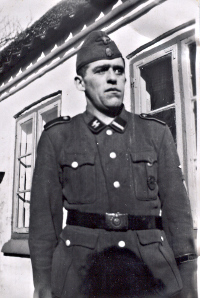

On 2 January 1942 I was granted Christmas leave until 10 January. On 4 January I arrived at Herfølge station, where my wife—who had an idea that I was coming—was waiting for me, and there was great joy at home. The days were spent visiting family and friends.
On 9 January I had to leave again, but my wife travelled with me to Næstved, where I was to board the express train. My wife then continued with me to Gedser, and there we parted as the ferry set sail. She stood on the platform and I on the ferry, and we both shed tears.
On 2 March 1942 we changed battalion commander, and the new one was C. F. v. Schalburg.
At Easter I again had a short leave, but this time we had to travel via Flensburg because the Baltic Sea was covered with ice. And there I forgot my gas mask at home; but a comrade, who had leave later, brought it back to me, so that mishap was avoided.
In early May the battalion went to the front. I travelled with the second group, which left on 14 May via Posen, Königsberg, Tilsit, Riga and Pskov, to Tulpeja (Tulelia?), from where we were flown into the pocket where the corps was engaged in combat with the Russians, and we immediately took part in the fighting against the Russians together with the “Totenkopf” Division.
Here I now saw with my own eyes how barbaric the enemy was. We found several of our comrades and Germans who had been tortured to death. Among other things, several with their eyes gouged out and their bellies cut open, and one German they had turned into an ox.
On 2 June our commander C. F. v. Schalburg fell, together with a part of the men, during an attack on the enemy.
On 5 June the battalion carried out a successful advance against the enemy and took a town called Boldobovitchi without suffering heavy losses itself.
When our troops were relieved on 7 June by the Wehrmacht, it was intended that we should go into “rest position” for a while. But already on 9 June the Russians went on the attack and retook the mentioned town from the Wehrmacht.
On 11 June at 2 o’clock we were ordered to retake the town and were positioned along a forest, which was to be our starting position at 4 o’clock when the attack was to begin. But then the Russians got ahead of us and began a heavy artillery bombardment, during which I received a splinter in my arm and had to return to the aid station, which was about 3 km behind the line.
When I returned to my comrades, they had already gone into the attack, and I moved on without meeting anyone until I came out of the forest. Here I saw on a hill about 400 meters ahead that green uniforms were moving. I ran up there and saw that they were men from “Totenkopf,” and they told me that the Free Corps had gone into an attack in a forest lying next to our starting position and in the direction of the village.
Since an artillery barrage from the enemy side then began on the hill, I had to take cover there and wait. But then a shell landed right next to me and three Germans. As a result, we were covered with a whole shower of earth, and I ran away from them and back down into the forest, where I met the commander of 1st Company “Per Søren,” who showed me in which direction 2nd Company had gone.
I then made my way in that direction and went all the way through the forest without encountering either friend or enemy. From the edge of the forest I could see the village about 500 meters ahead, but I did not dare go up there because I did not know who controlled it, and therefore lay down, expecting that something would soon appear to give me information.
I had only been lying there for 10 minutes before I realized the danger I was in. Our infantry guns began firing at the village, and I can only tell the reader how I felt—my heart was beating so loudly that I could hear it.
I then began a rapid withdrawal through the forest, which took about an hour, and I did not meet so much as the shadow of a Russian. What had happened was that the Wehrmacht, which was supposed to attack together with us, had been pushed back, and the Russians had attacked the Free Corps on the flank.
When I returned to the starting position, a machine gun was pointed at me and I had to raise my “rifle” and arms before they realized who I was.
Later, we sent out a reconnaissance patrol to the enemy side. It was led by the 2nd Company commander, Hauptsturmführer Bonnich. We went over to the Russians and were all placed on guard, while the commander with a couple of men obtained the desired information.
We were then gathered again and went back in single file, as one always does at the front, returning to our lines.
At that point I noticed that I was missing an ammunition box as second machine gunner, and I knew that one of my comrades, H. C. Pedersen (“Tante”), had been carrying it for me. I realized he had not returned.
I raised the alarm, and a man was sent out together with the company commander, who brought him back unharmed.
On 17 July and the following days I will also never forget. We were subjected to a Russian fire attack, which turned the wooded terrain into an open battlefield, and many of my comrades fell and even more were wounded.
On 4 August 1942 we received marching orders to the town of Mitau in Latvia, which we reached on 12 August; but already the following day I was sent to a hospital in Riga with a disease called dysentery. Riga is a very beautiful city and lies at the mouth of the Daugava River.
On 26 August I was discharged from the “Rotenberg” hospital and received marching orders to Treskau, where I arrived on 30 August.