
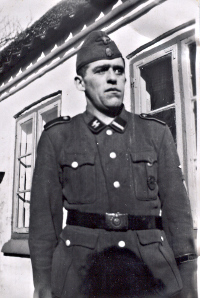

On 5 September the journey home began for a long leave that the entire battalion had been granted for its efforts at the front. We arrived in Copenhagen on 9 September, where we were received by family and party comrades, after which we marched together out to the Citadel (Kastellet), where accommodation arrangements were made. The company I belonged to was placed at “Bossen” [Bådsmandstræde Barracks].
I had expected to meet my wife among those who received us, so I went that evening to her cousin in Valby to eat, since we did not have any Danish currency. And 10 minutes after I had left, my wife arrived at “Bossen,” but the Bird had flown.
The next day we had a large parade at the artillery barracks on Amager for senior German officers, and there I met my wife and little daughter, who had been born on 2 May 1942.
On the evening of the 11th a happy family then travelled to H, where we were to spend 4 weeks together. Time passed far too quickly. We attended various gatherings, and had a christening, and our little daughter was given the name Rita.
On 8 October the leave was over, and many young wives and older mothers shed bitter tears when the corps was once again to depart for new assignments. Just before the train was due to leave, I was ordered to report to the replacement command in Jernbanegade as a witness in a case, and there I was granted an additional 10 days of leave.
On 10 October I then said goodbye to my wife at the Central Station, and the journey went to Mitau, Posen, Minsk and Bobruisk, where I stayed until we were deployed again on 1 December 1942. This time the journey went to the Nevel–Velikiye Luki front, where we came under the command of the 1st SS Brigade.
We changed positions several times before Christmas, but on 27 December we got a fixed front, and our group, consisting of a leader and 6 men, was given a position called “Alcazar.” On 27 and 29 December (my wedding anniversary), our group was completely surrounded by the Russians.
On 31 December I was promoted to Rottenführer.