

Translation of the Article
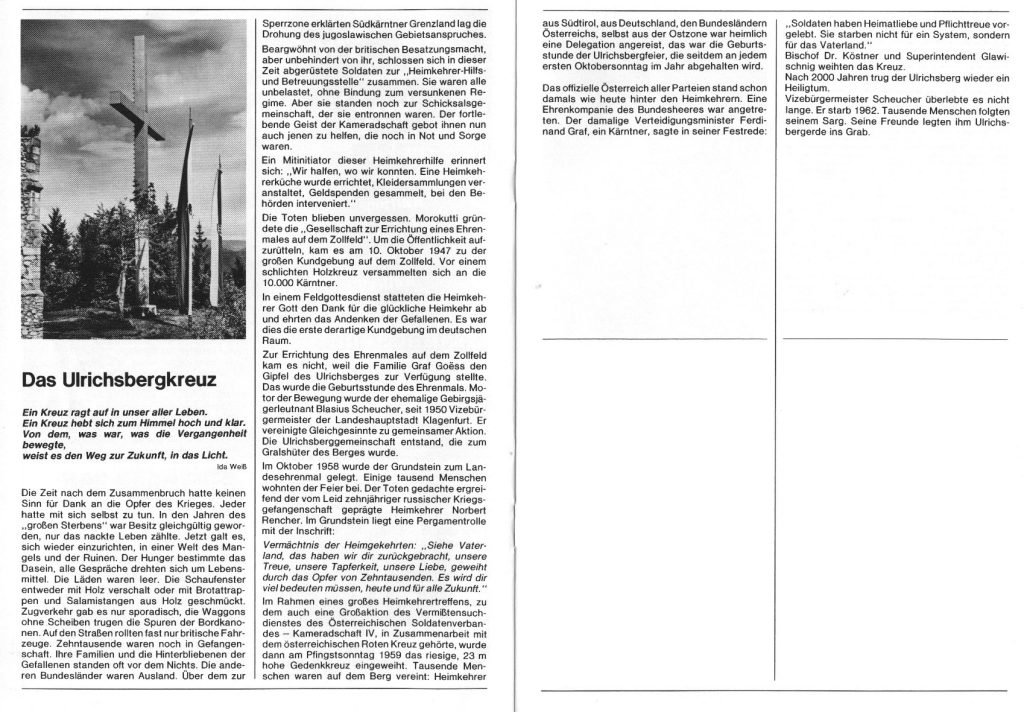
A cross rises into all our lives.
A cross reaches toward the sky, high and clear.
From that which moved us,
it shows us the way toward the future, toward the light.
Ida Weiß
The period after the collapse left no room for gratitude toward the victims of the war. Everyone had enough to deal with on their own. During the years of the “great deception” under the occupation, the world had become cold, harsh, and merciless. Now people once again found themselves alone in a world of shortages and ruins. Hunger dominated daily life, and conversations revolved around food. The shops were empty. Windows were either boarded up with wood or covered with roofing felt, and salamis hung on wooden frames as decoration. Train services operated only sporadically, while freight wagons moved along the roads in border regions without rails. On the streets, almost only British vehicles could be seen. Tens of thousands were in captivity. Their families and the relatives of the fallen were often left with nothing. The other federal states felt like foreign countries.
Over the southern Carinthian border region hung the threat of Yugoslav territorial claims. Viewed with suspicion by the British occupation authorities, yet otherwise left untouched by them, returning soldiers joined together during this period in the “Homecomers’ Aid and Support Office” (Heimkehrer-Hilfs- und Betreuungsstelle). They were all free of incriminating associations and had no connection to the collapsed regime. Yet they still belonged to the community of shared fate from which they had returned. The enduring spirit of comradeship now also called upon them to help those who were still living in hardship and anxiety.
One of the initiators of this aid organization for returning soldiers recalled:
“We helped wherever we could. A hostel for returning soldiers was established, clothing drives were organized, monetary donations were collected, and interventions were made with the authorities.”
The dead were not forgotten. Morokutti founded the “Society for the Construction of a Memorial Monument on the Zollfeld.” To raise public awareness, a large gathering was held on the Zollfeld on 10 October 1947. Ten thousand people from Carinthia gathered before a simple wooden cross.
At an open-air religious service, the returning soldiers thanked God for their safe return and honored the memory of the fallen. It was the first gathering of its kind in the German-speaking world.
The construction of the memorial on the Zollfeld never came to fruition because the Goëss family made the summit of Ulrichsberg available. This became the birth hour of the memorial. The driving force behind the movement was the former mountain infantry lieutenant Blasius Scheucher, who from 1950 served as deputy mayor of the provincial capital, Klagenfurt. He brought together like-minded people for a common cause. Thus the Ulrichsberg Community was founded and became the guardian of the mountain.
In October 1958, the foundation stone of the memorial was laid. Several thousand people took part in the ceremony. The memory of the dead was honored by the returning soldier Norbert Rencher, who bore the marks of the suffering endured during many years of Russian captivity as a prisoner of war.
Inside the foundation stone lies a parchment scroll bearing the inscription:
“See, fatherland, this is what we have brought back to you: our loyalty, our courage, our love, sanctified through tens of thousands of sacrifices. It will mean much to you, today and for all future.”
As part of a large reunion of returning soldiers, which also included a major operation by the search service of the Austrian veterans’ association — “Kameradschaft IV” — in cooperation with the Austrian Red Cross, the enormous 23-meter-high memorial cross was inaugurated on Pentecost Sunday in 1959.
Thousands of people gathered on the mountain: returning soldiers from South Tyrol, from Germany, from the Republic of Austria, and even from the Eastern Zone, where a delegation had secretly made its way to attend. This marked the birth of the Ulrichsberg gathering, which has since been held every year on the first Sunday in October.
The official representatives of all parties at that time, as now, stood behind the returning soldiers. An honorary company of the Bundesheer was present. The then Minister of Defence, Ferdinand Graf, a Carinthian, said in his ceremonial speech:
“Soldiers lived the love of their homeland and loyalty to duty. The dead did not die for a system, but for the fatherland.”
Bishop Dr. Köstner and Superintendent Glawischnig consecrated the cross.
After 2,000 years, Ulrichsberg once again bore a sacred site.
Deputy mayor Scheucher did not live to see it for long. He died in 1962. Thousands of people followed his coffin. His friends placed soil from Ulrichsberg in his grave.
Translation of the Article
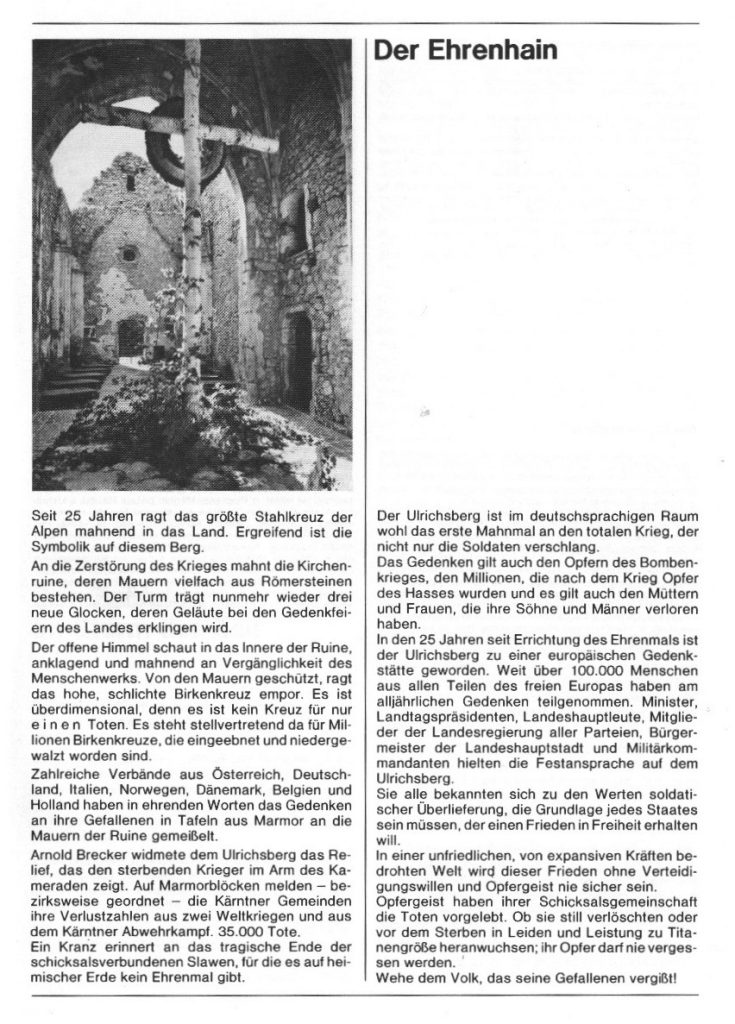
For 25 years, the largest steel cross in the Alps has stood as a sign of admonition, towering over the land. The symbolism of this mountain is deeply moving.
The ruins of the church, whose walls in many places consist of Roman stones, are a reminder of the destruction of war. The tower now again carries three new bells, whose sound will ring out on the nation’s days of remembrance.
The open sky looks into the interior of the ruin, accusingly and admonishingly reminding us of human transience. Sheltered by the walls, a tall, simple birch cross rises. It is oversized, for it is not only a cross for one dead. It stands as a surrogate for millions of birch crosses that have been levelled and trampled down.
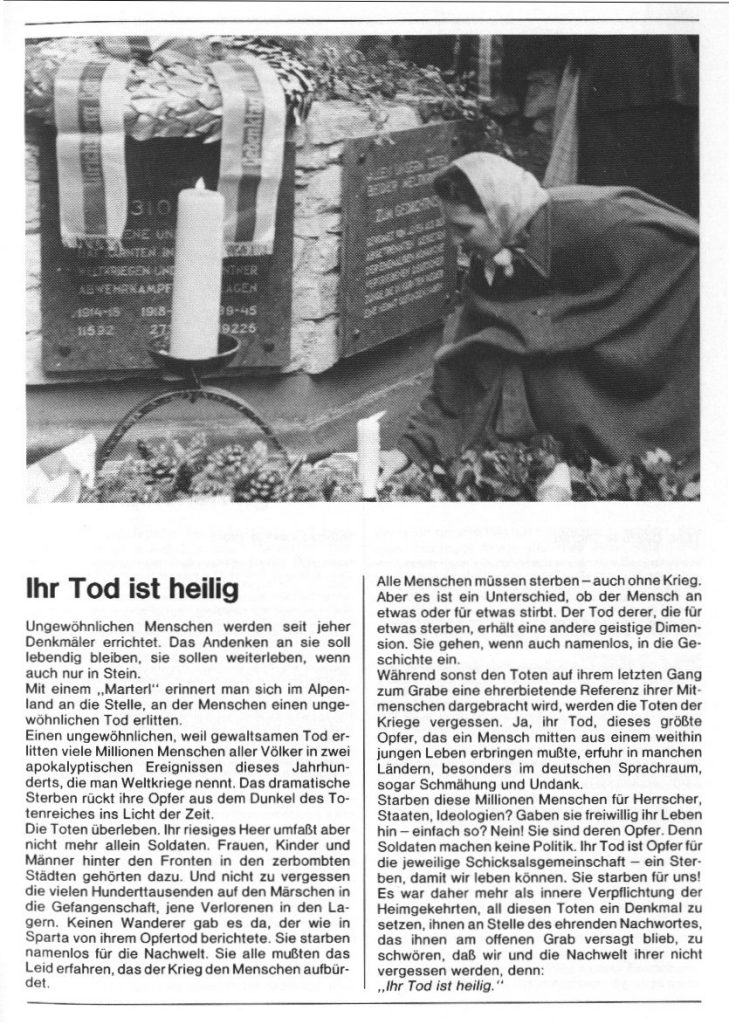
Numerous associations from Austria, Germany, Italy, Norway, Denmark, Belgium, and the Netherlands have inscribed the memory of their fallen in marble plaques on the walls of the ruin, in words of honor.
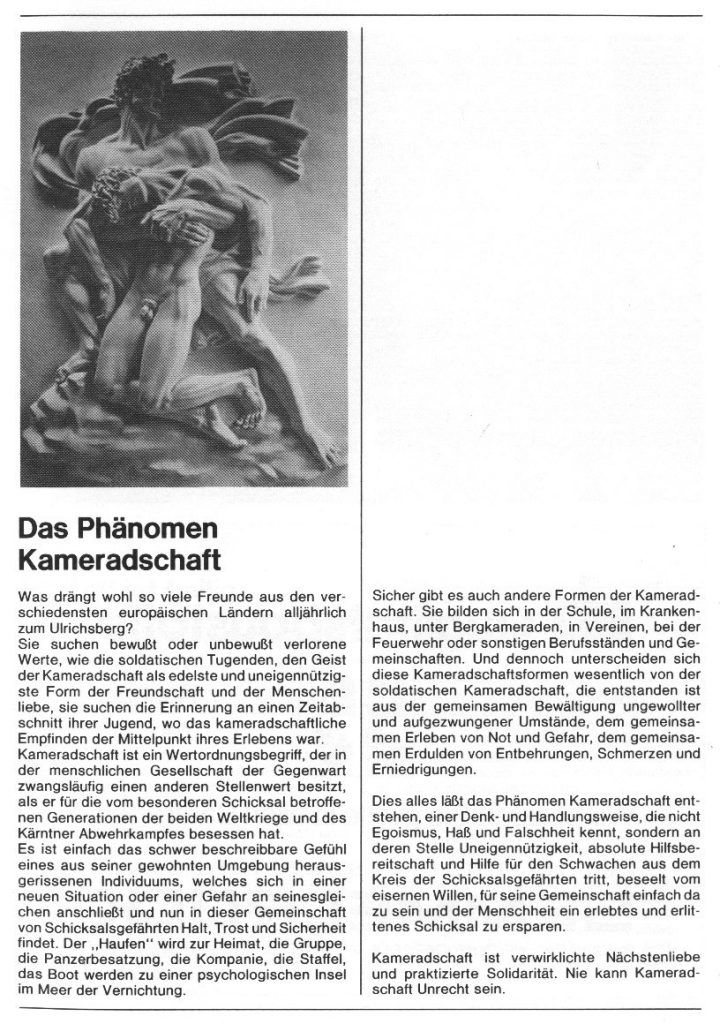
Arnold Breker dedicated the Ulrichsberg relief, which depicts the dying warrior in the arms of his comrade. On marble blocks are listed the losses of the Carinthian municipalities from the two world wars and from the Carinthian defensive struggle — in total 35,000 dead.
A wreath recalls the tragic fate of the fated slaves, for whom no memorial exists on their native soil.
Ulrichsberg is probably the first memorial in the German-speaking area dedicated to total war, one that does not only include soldiers.
The remembrance also includes the victims of the bombing war, the millions who after the war became victims of hatred, and it also includes the mothers and women who lost their sons and husbands.
In the 25 years since the construction of the memorial, Ulrichsberg has become a European place of remembrance. Well over 100,000 people from all parts of a free Europe have taken part in the annual commemorative ceremony.
Ministers, presidents of regional parliaments, members of state governments from all parties, mayors from the provincial capital, and military commanders delivered ceremonial speeches at Ulrichsberg.
They all professed adherence to the values of the soldierly tradition, which must form the foundation of any state seeking to preserve peace in freedom.
In an unsettled world, threatened by expansionist forces, such peace is not secure without a willingness to defend it and a willingness to make sacrifices.
The dead, through their shared fate, lived sacrifice in advance. Whether they passed away quietly or, before their death, grew into titanic achievements through suffering and effort, their sacrifice must never be forgotten.
Woe to the people who forget their fallen!
Translation of the Article
What then drives so many friends from different European countries to travel to Ulrichsberg every year?
They consciously or unconsciously seek lost values, such as soldierly virtues and the spirit of comradeship as the noblest and most selfless form of friendship and human solidarity. They seek the memory of a period in their youth when the feeling of comradeship was the center of their lives.
Comradeship is a value concept which in today’s human society has inevitably taken on a different meaning than for the generations that were particularly affected by fate during the two world wars and the Carinthian defensive struggle.
It is, quite simply, the difficult-to-describe feeling of an individual who has been torn out of their familiar surroundings and who, in a new situation or in danger, joins like-minded others and, within this community of shared fate, finds support, comfort, and security.
“The pack” becomes a home; the group, the tank crew, the company, the staff, the boat becomes a psychological island in a sea of destruction.
Of course, there are also other forms of comradeship. They are formed in schools, in hospitals, among miners, in associations, in the fire service, or in other professions and communities.
Nevertheless, these forms of comradeship differ significantly from soldierly comradeship, which arises through the shared mastery of extraordinary and imposed circumstances, the shared experience of hardship and danger, and the shared endurance of deprivation, pain, and humiliation.
All of this creates the phenomenon of comradeship – a way of thinking and acting that knows no egoism, hatred, or deceit, but instead selflessness, absolute helpfulness, and support for the weak within the circle of those bound by fate, carried by an iron will to simply exist for one’s fellow human beings and for humanity, and to spare them from a fate that has been experienced and endured.
Comradeship is realized compassion and practiced solidarity.
Comradeship can never be unjust.
Translation of the Article
Extraordinary people have, since ancient times, been given monuments. The memory of them must remain alive; they shall live on, even if only in stone.
Extraordinary people have, since ancient times, been given monuments. The memory of them must remain alive; they shall live on, even if only in stone.
An extraordinary death, because many millions of people from all nations suffered a violent death in this century’s two apocalyptic events, known as world wars. Their dramatic death draws its victims out of the darkness of oblivion and into the light of time.
An extraordinary death, because many millions of people from all nations suffered a violent death in this century’s two apocalyptic events, known as world wars. Their dramatic death draws its victims out of the darkness of oblivion and into the light of time.
All people must die — also without war. But it makes a difference whether a person dies from something or for something. The death of those who die for something gains a different spiritual dimension. They pass, even if nameless, into history.
While the dead are otherwise accompanied on their final journey to the grave with the respect of their fellow human beings, the war dead are forgotten. Indeed, their death—this greatest sacrifice a human being can make in the midst of what would otherwise have been a long life—was in some countries, particularly in the German-speaking area, even met with scorn and ingratitude.
Did these millions of people die for rulers, states, and ideologies? Did they voluntarily give their lives—simply like that?
No! They are the victims. Soldiers do not make policy. Their death is a sacrifice for the respective community of fate — they died so that we could live. They died for us!
Therefore, it was more than an inner obligation for the returning soldiers to erect a memorial for all these dead, and instead of the honourable remembrance that was often denied them at their open graves, to swear that we and future generations will not forget them, for:
“Their death is sacred.”
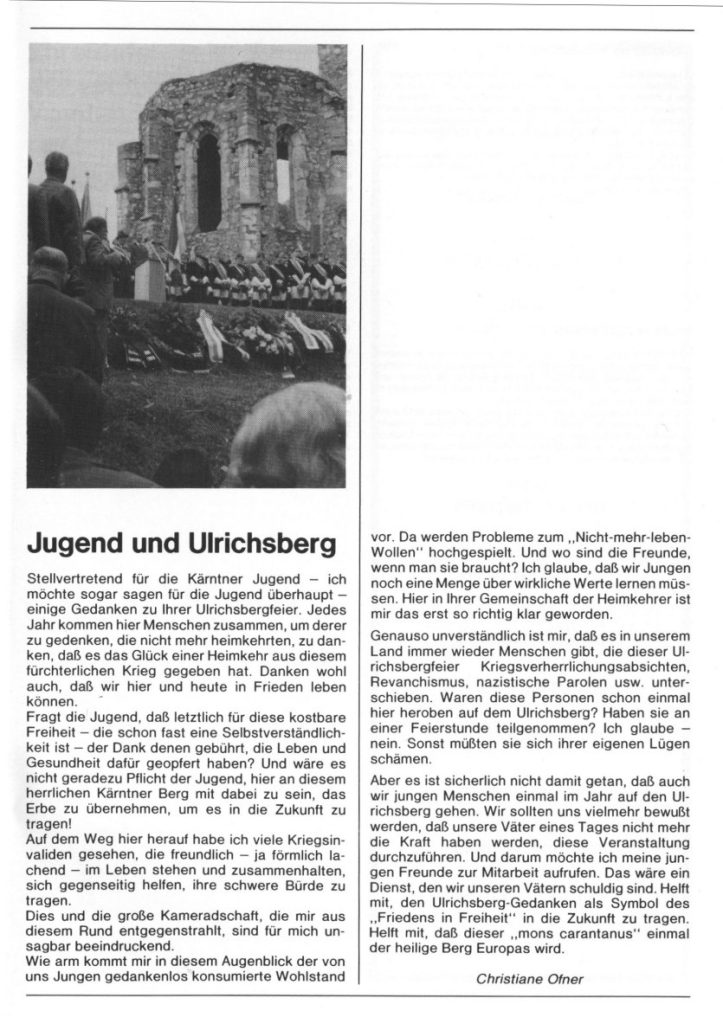
Translation of the Article
As a representative of Carinthia’s youth — I would even say of youth in general — I would like to share some thoughts about the Ulrichsberg commemoration.
Every year, people gather here to remember those who did not return home, to give thanks for the happiness of having returned from this terrible war. Gratitude also that we here and today can live in peace.
If one asks the youth whether it was ultimately for this precious freedom — which has almost become a matter of course — that the Danes sacrificed life and health, would it not then be precisely the duty of the youth here on this magnificent Carinthian mountain to take over this legacy and carry it forward into the future?
On the way up here, I saw many war invalids who, kindly—indeed almost smilingly—stand in life, hold together, help one another, and carry their heavy burden.
This, and the great comradeship that radiates toward me from the entire area, is very impressive to me.
How strange it seems to me at this moment that our youth so thoughtlessly consume prosperity and turn it into problems of “no longer wanting to live.” And where are the friends when one needs them?
I believe that we young people still have much to learn about true values. Here in the community of returning soldiers, this has for the first time become truly clear to me.
Equally incomprehensible to me is that in our country there are, again and again, people who accuse this Ulrichsberg commemoration of glorifying war, revanchism, and Nazi slogans.
Have these people ever been up here on Ulrichsberg? Have they taken part in a single commemorative ceremony? I don’t think so. Otherwise they would have to be ashamed of their own lies.
But it is certainly not enough that young people go up to Ulrichsberg only once a year.
We should be much more aware that our fathers will one day no longer have the strength to carry out this event.
And therefore I would urge my young friends to help.
It would be a service we owe our fathers.
Help carry the Ulrichsberg idea as a symbol of “peace in freedom” into the future.
Help ensure that this “mons carantanus” one day becomes Europe’s sacred mountain.
Christiane Ofner