
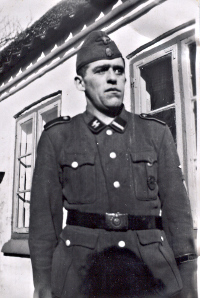

My father was born in K., and my mother was from S. and the daughter of Chr. Christensen, who took part in the War of 1864.
My father and mother were married on November 15, 1907, and took over my grandfather’s property in K., which consisted of 7 tønder land (acres of farmland).
I was born on October 10, 1908, and in time I had four siblings: three brothers and one sister.
When I was about five years old, I stayed for a short period with my aunt in S. during my mother’s illness.
On October 14, 1914, my grandfather died.
I also vaguely remember that the World War broke out in 1914, and our neighbor was called up to the Security Force.
The first fire I ever saw was when Veterinarian Jensen’s property in A. burned down, and it was also in his car that I rode as a passenger for the first time.
Twice—when I could barely button my trousers—my sister and I walked to S., pulling a little wagon behind us. One time we went to my aunt’s place and the next time to my uncle’s, both times without permission, and on both occasions we were escorted home by our cousin, who was a little older than us.
On one occasion, I wanted to make myself useful while we were harvesting rye. I wanted to help with the binding, and was unfortunate enough to stick my head into a wasps’ nest that had been built in the rye field.
I had to stay in bed for several days.
1916
In the spring of 1916, my father bought a larger property in S., and on April 4 we moved in. My sister and I helped lead the cows to their new home.
A few days later, my sister and I started school with an elderly lady named Miss Jensen.
When we boys walked home from school during the summer, we were expected to have our daily bath, and this took place in a marl pit nearby. Since we little “youngsters” were afraid of water at first, my cousin and the other big “lads” would grab us by the head and the other end and give us a proper dunking, which cured us of it in the future.
On all holidays during the summer, we were either in the woods, where we played “Robbers and Soldiers,” searched for cards and objects that the opposing side had hidden, or we played longball, basketball, and later football, as well as other games.
In the winter, I attended gymnastics, and after my confirmation I went to evening school.
1918
When we were about ten years old, we had to begin working.
In 1918, my grandmother died, and at the beginning we were in Sonnerup. Around the same time, the Spanish Flu appeared, and many people—young and old—died from it.
That same year, on May 1, we got a new schoolteacher named Georg Elm. At first, he lived in A. Every morning he came riding on his B.S.A. motorcycle.
He was a good teacher, much loved by both children and older people throughout the parish, and he took a great interest in sports, including gymnastics, football, and shooting. For 25 years, he also ran the evening school for the young people of the parish.
1920
In 1920–21, a number of viaducts were built over the railway line, including one on our field through which the railway passed, and all the town’s children and young people were greatly interested in it. In the evenings, we rode the tip wagons.
In the summer of 1922, I attended confirmation classes and was confirmed on October 1 by the former Minister of Ecclesiastical Affairs, P. Dahl, who at that time was a member of parliament and a very good friend of Thorvald Stauning.
1923
When I was 15 years old, I got my first bicycle from “Blacksmith Jørgen” in A., and then the wild chase into the countryside began on Sundays, including trips to Ringsted and Næstved, and in the evenings out to Lilleskov, where the young people gathered.
Once, we came up with the idea of placing “packages” out on the country road with a thin string attached that reached into the woods where we were hiding. When cyclists came by, they would jump off their “steed” and try to pick up the package, but it would move away when they bent down to grab it, and then we would quickly disappear deep into the forest.
We even did it to the Minister of Ecclesiastical Affairs, P. Dahl.