
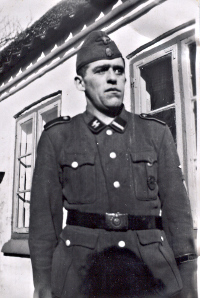

Monday, 8 April at 11 o’clock, 1946.
Then came my “Judgment Day” early in the morning. I washed and shaved and put on my new clothes, and ate breakfast. At 9:30 two officers came and fetched me and a comrade, who was also to be “hit.” We were taken to the police station and placed in a cell.
At 10 o’clock my comrade was brought before the court and received 10 years for a bicycle ride. At 11:15 I was brought before the high court and charged with having been in the “Free Corps Denmark” and subsequently transferred to the Schalburg Corps. At 12 o’clock the hearing was finished, and I was taken back to the “hole” again.
At 13:00 I was again brought up to the court, after which the judge pronounced the sentence for my offence:
“THEREFORE IT IS ADJUDGED, the accused HCJ, born 10-10-08 in S, is sentenced under the Penal Code of 1 June 1945, Section 10(1), to 3 years’ imprisonment, with a deduction of 11 months of pre-trial detention.”
I did not accept the judgment, but was granted 14 days to consider an appeal, and on 18 April my defence counsel applied to the appeals authority to have the case brought before the High Court.
On 18 May I was at the Chief of Police, who wanted me to begin serving my sentence, which I, however, had little interest in. I then applied for clemency on 19 May.
On 7 June 1946, 20 men—including myself—were transferred to Sct. “Jørgensbjerg School” in Roskilde. We were taken there by bus and arrived around midday, and it was straight into “the hole in the wall.” We were undressed, searched, and dressed in prison clothes.
There I met many of the fellows from the “Free Corps,” as well as my brother, and I managed to greet him briefly. In the evening he arranged to meet me in the toilets, where we managed to talk a little.
Eight days later I moved into room 4, where all the Køge inmates as well as my brother were housed. I immediately got into trouble.
On 11 July I was informed that my application for clemency had been rejected. I now had to begin serving my sentence, and was assigned to work in the flower department, where my brother was also.
On 26 August I was taken to St. Maria Hospital, where I underwent an operation for an abscess under my armpit, which had been troubling me for some time. There I was granted 16 good days without prison supervision.
The day after I arrived, at around 9 o’clock, I was operated on, and after I had somewhat recovered, I borrowed 25 øre from my cellmate for writing paper and postage and wrote a few words to my wife. She then visited me 4–5 times during the period I was there, and we finally had a proper talk about what happened on 5 May 1945.
I received many good and tasty things that were not permitted in prison.
On 13 September I was discharged and driven back to “Sct. Jørgensbjerg,” to the daily yard walks, the rattling of keys, and not forgetting the water porridge.
On 10 October, my birthday, I had a visit from my mother, wife, and daughter, where I drank a little chocolate and ate a couple of cakes.
Around 1 November we were allowed to hold chess matches, where each room fielded a team of 8 men, who then played against each other.
On 8 December I and a comrade were moved to the concentration camp “Horserød” near Helsingør. It was a camp which I believe was worse than German camps of the same name. In Germany the prisoners could move freely within the camp area (the barbed wire), whereas we were locked into a small room, four men in each.
Here I was assigned to work in the tailoring workshop, where I pressed military uniforms for the Danish Brigade in Germany, which was to help maintain peace and order in Germany. At Christmas a common room was set up, where the prisoners were occasionally allowed to gather. We could read, play chess, and speak quietly together; but towards spring we were there almost every evening.