
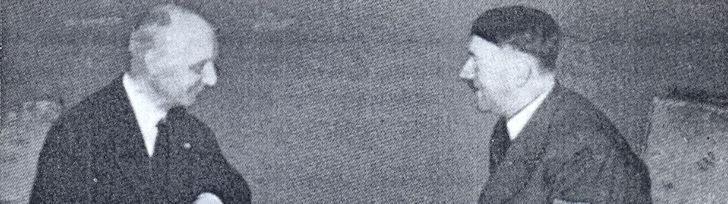
On Thursday, 14 March 1940, the German military attaché Renthe-Fink appeared at the Ministry of Foreign Affairs and presented his credentials along with major demands to the government, demands so serious that Prime Minister Thorvald Stauning convened his ministers for an emergency meeting the same day.
In addition to the Prime Minister, the meeting was attended by Defence Minister Alsing Andersen, Finance Minister Vilhelm Buhl, Foreign Minister P. Munch, Member of Parliament Julius Bomholt (believed to have participated), and Justice Minister Svend Unmack Larsen. The situation was critical. During the discussions, it was agreed to comply with the German demands and that the long-serving Radical diplomat and former Foreign Minister Erik Scavenius—who had built up a good relationship with Germany over many years—was the right person to be sent to negotiate with von Ribbentrop, but Scavenius declined, resulting in P. Munch himself having to go.
At 4:00 a.m. on Palm Sunday, 17 March—three weeks before the German occupation, while it is still dark—a car arrives at Kastrup Airport. In the vehicle are Foreign Minister Peter Munch together with intelligence officers Volmer Gyth and naval officer Poul Adam Mørch from the Army General Staff’s intelligence service. (FJL comment: there is some uncertainty as to whether the two mentioned officers were actually part of the trip, or whether they merely accompanied Munch to the aircraft).
At the runway a German aircraft of the Fieseler Storch type is waiting. The three men board the plane, and the aircraft takes off. At the same time, Officer Ernst Momme receives orders from Reichsführer-SS Heinrich Himmler to collect three unnamed persons at the airfield in Rostock. Upon landing it is dark. The driver salutes and introduces himself by name and rank. They are then driven directly to a villa near Steintor on the outskirts of Rostock.
Indoors – behind blackout curtains – the delegation is welcomed by Foreign Minister von Ribbentrop, who offers a glass of champagne before they sit down at the negotiating table. Ribbentrop begins: “As you gentlemen are no doubt aware, Germany has been at war with England and France since September last year. You are also surely aware that the English have landed troops in Norway. For this reason, it is urgently necessary for us to occupy Norway as quickly as possible in order to prevent the English from gaining a foothold there. This, gentlemen, is the reason for our meeting!”
He continues: You are also likely familiar with our great military strategist General Claus von Clausewitz’s principle that the shortest path to the goal is the straight line. That doctrine we intend to follow. In this matter it means quite simply: we must have unhindered transit through your country for our troops toward the objective—Norway on 9 April. An offensive under the code name Weser-Übung.
In this connection we also demand unhindered passage for our navy through the internal Danish waters. Furthermore, the Danish government undertakes to call up only a minimum of military forces and to ensure that no German soldier loses his life during the operation. In addition, there is the demand that Denmark make at least 60,000 citizens available to the German labour market, voluntarily or by force, as compensation for our soldiers at the front.
The demands are accepted by P. Munch, and the date of the occupation is agreed to be the night between 8 and 9 April 1940. The intention is that it should appear as a surprise attack. For the same reason, the royal family must not be informed. Afterwards, a draft is prepared of King Christian X’s “proclamation” urging the population not to provoke the occupying power and to maintain calm and order. The agreements are signed by Ribbentrop and Munch. Later, the agreement is countersigned by Thorvald Stauning with the initials “Th.S.”
The meeting is over. Munch and his entourage are ready to return to Copenhagen, but are given the unfortunate message that they must take the train, as no aircraft is available.
The following day, around midday, a tired delegation arrives at Christiansborg. It is decided that Carl Allers Etablissement will be entrusted with printing the King’s proclamation, calling for calm and urging loyal conduct toward anyone exercising authority.
The poster/leaflet presents itself as a message from His Majesty, but is produced behind the King’s back. At the same time, Carl Aller is also entrusted with printing various ration coupons. A few days later, the country’s police chiefs receive instructions in sealed envelopes. The seal must not be broken before 6 a.m. on 9 April. The misprint is a deliberate diversion, with the sole purpose that the population should believe the printed material was produced in Germany.
On 3 April 1940, the director of the Reich Ministry (now the Ministry of Defence), Major General von Stemann, handed over a report on Danish military positions to the German envoy and military attaché Cecil von Renthe-Fink, who at that time was unaware of the Rostock agreement of 17 March.
On 8 April 1940, the day before the occupation, Foreign Minister Peter Munch summons the German Renthe-Fink. On behalf of the government, he promises the envoy that Denmark will capitulate under protest, which is implicitly not to be taken seriously. Thus, roughly 12 hours before the government’s and the King’s official decision on capitulation is made, Munch promises what actually happens the following day.
On the same day, the Danish admiral Rechnitzer and his German counterpart, Grand Admiral Erich Raeder, agree to coordinate the course of the operation. At 12 noon, Defence Minister Alsing Andersen issues the following order: whatever happens, the Copenhagen Air Defence Corps must not be activated. That same evening, the air defence soldiers go to sleep for the night with their doors locked from the outside. Only at 8:00 a.m. on 9 April are the doors opened again.
The Flakfort personnel are granted leave, and at the same time the trained gun crews of Middelgrundsfort are sent ashore. Half an hour before the German occupation of the country, Danish Admiral Rechnitzer allows Holmen’s Bastion to surrender.
A German troop transport ship runs aground in the Great Belt. Its captain records in the logbook: “The battleship Schleswig-Holstein ran aground on 9 April 1940 at about 3:00. Shortly before 4:00, two Danish torpedo boats were sighted from the bridge, which assisted and escorted our ship into port!”
Around 6 a.m. on 9 April 1940, a ship belonging to the German-owned Danish coal company KKKK (Copenhagen Municipal Coal Company) docks and unloads not coal, but soldiers. Shortly afterwards, the Citadel (Kastellet) is taken without resistance.
At around 8:00 a.m. on 9 April 1940, Carl Aller’s “proclamation” is seen on every street corner and dropped from German combat aircraft (remarkably how quickly printing could be done back then…). At 9:00 a.m. the same day, German soldiers storm Amalienborg Palace. They are met with live fire from the Royal Guard and police, precisely because the royal family had not been informed about the Rostock agreement.
In his capacity as head of the Border Guard, Vilhelm Buhl issues an order the day before the occupation that the corps must not open fire during the night between 8 and 9 April. Nevertheless, 16 Danish soldiers lost their lives.
The German navy passed unhindered through the Belt and Sound. At the same time, thousands of ground troops moved from the border to Frederikshavn, from where they were embarked for Norway.
As a result of his outstanding service, the Commander-in-Chief of the Danish armed forces, General Ebbe Gørtz, was promoted to lieutenant general and decorated after the end of the occupation. The commander of the occupying forces, General Leonard Kaupisch, moved into the Hotel d’Angleterre. From there he reported to Himmler: “Das dänische Volk und die Wehrmacht wurden überrumpelt!”
Had King Christian X known the true circumstances of the occupation, he would without doubt have brought the responsible ministers before the High Court of the Realm on charges of high treason. But what the citizens denounced as traitors; and many were convicted!
As a reward for his outstanding performance, the Chief of Defence, General Ebbe Gørtz, was promoted to lieutenant general and decorated after the end of the occupation. The commander of the occupying forces, General Leonard Kaupisch, moved into Hotel d’Angleterre. From there he reported to Himmler: “The Danish people and the Wehrmacht were taken by surprise!”
An old proverb says that the terrible thing about the truth is: if you seek it, you will also find it! Why was the country’s most hated man (Scavenius) not convicted as a traitor after the occupation?
Despite their party affiliation, Munch and Scavenius were not friends. This later resulted in an accusation of treason. It was brought against Erik Scavenius until 1948, when Hans Hedtoft took over the office of Prime Minister, and the case against Scavenius was quietly dropped.
On 15 June 1945, a parliamentary commission was appointed to investigate the circumstances surrounding 9 April 1940. The result was as follows: As regards the position of the leading responsible persons, nothing whatsoever has emerged that could justify that anyone—be it a minister or a leading military or diplomatic figure—has made themselves guilty of acts of a treasonous nature. The collected material shows that there can be no question of bringing impeachment proceedings against any minister for the events surrounding 9 April. The investigations have primarily focused on the participation of Foreign Minister P. Munch and former Defence Minister Alsing Andersen! End of quote.
In November 1942, Erik Scavenius became both Prime Minister and Foreign Minister. Because he knew his ministerial colleagues, he took a copy of the “surprise agreement” as protection in case anyone might stab him in the back after the war. A precaution that proved wise. Scavenius asked Hans Hedtoft to read the contents of the surprise agreement as well as the intelligence officers’ description of the journey’s course, resulting in the charges against him for subversive activity being dropped.
Historikeren Frederik Dessau stated on DR some years ago: The five cursed years only became cursed at the moment it became clear to the population that Germany would lose the war!
From an unnamed source within the army I have been informed of the following: The plans for the impending occupation were a known fact in Denmark already before this meeting (the Rostock meeting).
I can inform you that the General Staff’s Intelligence Section in 1938 established a communication network in both Germany and Poland, precisely with the purpose of monitoring the growing threat from the south. The head of the General Staff’s Intelligence Section, E. M. Nordentoft, appointed his deputy in the section, cavalry captain Hans M. Lunding, to carry out the task.
He was born in Southern Jutland and had been required to serve in the German army during World War I. In addition, he was an internationally known equestrian and had participated in the Olympic Games in Berlin in 1936, where he had made contact with both German and Polish officers.
The chief returned and gathered the few officers we had in the intelligence service at that time, and then he looked at me and said: “You are to solve that task, because you are an old Prussian; no one can tell by listening to you that you originate from Denmark,” Lunding recounts in an unpublished interview conducted by teacher Børge Mørk in 1983.
Lunding began his work by establishing an agent network in Germany, among other things by contacting former trade unionists in Germany through Danish Social Democrats.
The information that flowed to the General Staff from Lunding’s agent network was, of course, predominantly of a military nature, but if Denmark was to have the opportunity to make an overall assessment of what was happening in Germany and what significance it could have for Denmark, it was necessary to obtain information on several levels.
The extent to which this awareness existed at government level in the lead-up to the occupation can only be speculated about today, but due to one of diplomacy’s subtleties, Denmark obtained a “listening post” in Berlin from the end of 1939.
The Shipowners’ Association wished for a naval attaché to be sent to London to safeguard the interests of shipping. In order to maintain Danish neutrality, a corresponding attaché also had to be sent to Berlin. On 1 December 1939, Commander Captain F. H. Kjølsen was therefore posted to the German capital.
The information he brought home naturally came from other levels and was of a more political nature than what Lunding’s agents provided.
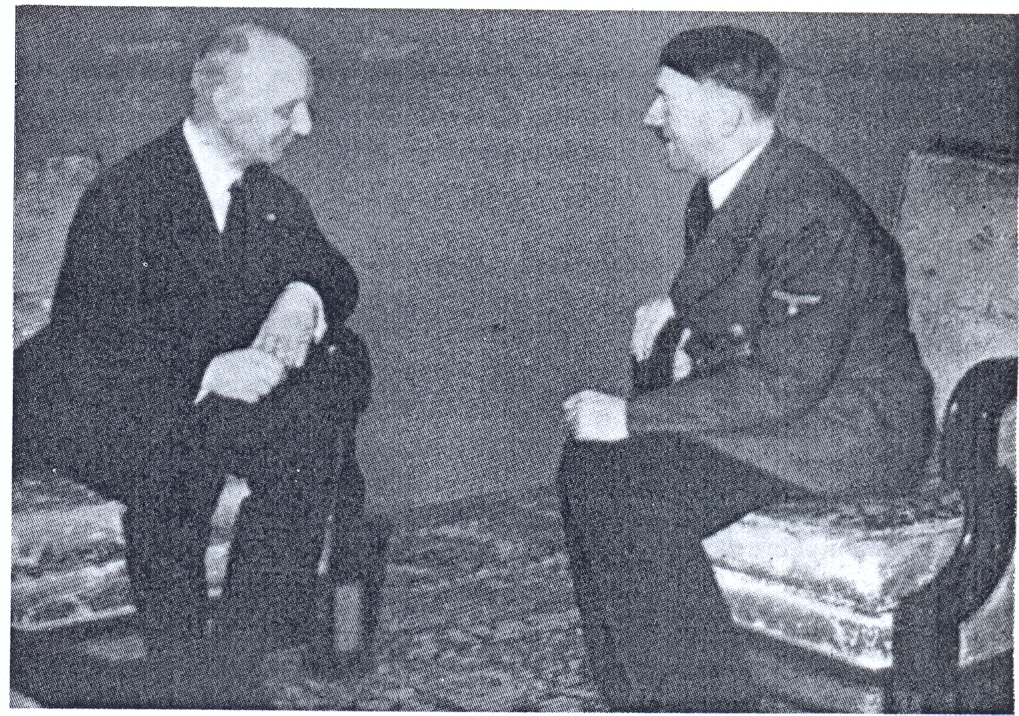
Danish Scavenius holds a meeting with A. Hitler
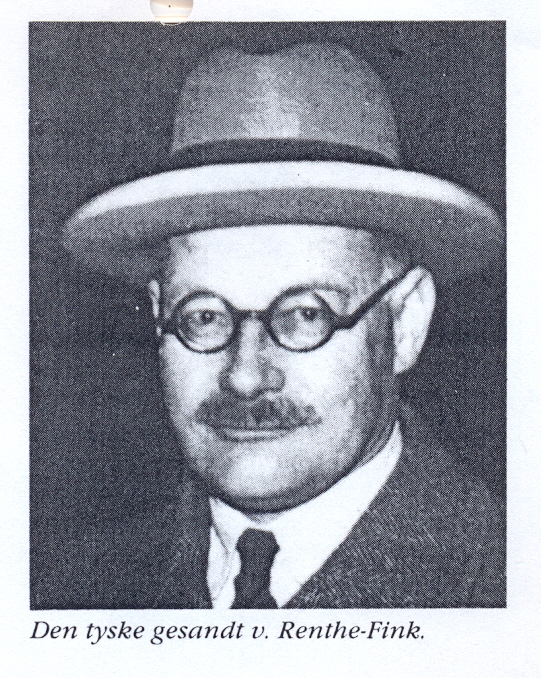
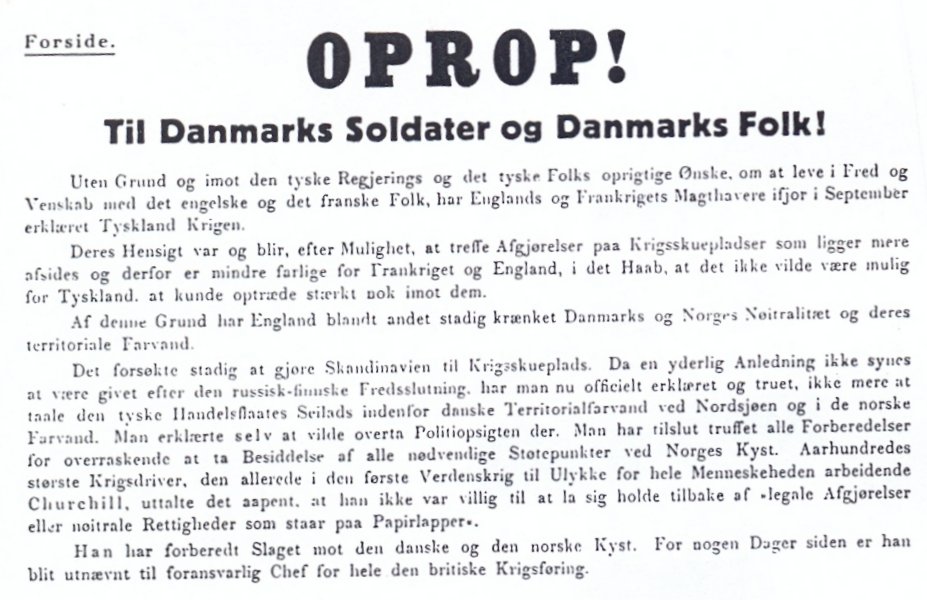
Envoy Renthe-Fink as well as a version of the “Proclamation”
1/ The Masks Fall Away, Ole Hans Jensen, 1993. ISBN 87-89926-00-5
2/ My Time, Vilhelm Leifer, 1987. ISBN 87-555-1111-2
3/ Conflict – Game in the Dark, Jan Pieter Kardam, 1967. (A book that was banned and withdrawn).
4/ www.kasler-journal.dk includes, among other things, an article on a comparative verifiable hypothesis concerning Munch and Himmler, March 1940.
5/ Bjørn Svensson, Haderslev, has, as an editor, on several occasions addressed the topic in newspaper articles.
6/ Historian Peer Henrik Hansen has likewise addressed the topic in newspaper articles, stating: It is pure invention and only a myth – Denmark could never have come up with such a thing.
7/ Success and Resistance, Hans Chr. Bjerg, 1995. ISBN 87-983989-4-6
8/ www.thomasstaermose.dk (the absolutely best and most historical treatment of the subject).
In the years leading up to 9 April 1940, the Danish military intelligence service had a network of agents in Germany. Could 9 April 1940 have been avoided, or could Denmark at least have acted differently?
It is one of the historical and political questions that has been widely debated throughout the post-war period, and not least this spring, where the 60th anniversary of Denmark’s liberation has created renewed interest in the occupation period.
A comprehensive answer to the question can probably not be given, but we can try to understand why things developed as they did by looking at some of the conditions the Danish politicians had for making the decisions they did. And here the Danish military intelligence service plays a not insignificant role.
In 1938, on the basis of German rearmament, it was decided at Danish political level that one wished to monitor developments south of the border more closely.
The head of the General Staff’s Intelligence Section, E. M. Nordentoft, appointed his deputy in the section, cavalry captain Hans M. Lunding, to the task. He was born in Southern Jutland and had been required to serve in the German army during World War I. In addition, he was an internationally known equestrian and had participated in the Olympic Games in Berlin in 1936, where he had made contact with both German and Polish officers.
“‘The chief came back and gathered the few officers we had in the intelligence service at that time, and then he looked at me and said: You are to carry out that task, because you are an old Prussian; no one can hear that you originate from Denmark,’ Lunding recounts in an unpublished interview conducted by teacher Børge Mørk in 1983.”
Lunding began his work by establishing an agent network in Germany, among other things by contacting former trade unionists in Germany through Danish Social Democrats.
“I focused on building an agent network along the easternmost and westernmost south-/northbound railway lines and roads in Schleswig-Holstein,” Lunding explains.
In addition, he also established agents along the German Baltic coast as well as in Poland. The communication network in Poland naturally ceased to function after the German occupation of the country in September 1939.
The value of Lunding’s agent network, in relation to how the Danish government used the intelligence, was probably not very great. The quality of the reports in purely military terms was not lacking, but—as we will return to later in the article—there were other factors involved which meant that the full benefit of the German agents’ information was not obtained.
The information that flowed to the General Staff from Lunding’s agent network was of course predominantly of a military nature, but if Denmark was to have the opportunity to make an overall assessment of what was happening in Germany and what significance it could have for Denmark, it was necessary to obtain the information at several levels.
The extent to which this awareness existed at government level in the lead-up to the occupation can only be speculated about today, but due to one of diplomacy’s subtleties, Denmark obtained a “listening post” in Berlin from the end of 1939.
The Shipowners’ Association wished for a naval attaché to be sent to London to safeguard the interests of shipping. In order to maintain Danish neutrality, a corresponding attaché also had to be sent to Berlin. On 1 December 1939, Commander Captain F. H. Kjølsen was therefore posted to the German capital.
The information he brought home naturally came from other levels and was of a more political nature than what Lunding’s agents provided.
Naval attachés were not a permanent institution in Denmark in 1939, and Kjølsen had to forward his messages through the Ministry of Foreign Affairs, even though he formally belonged to the Ministry of the Navy. At the same time, Lunding’s messages were received in the General Staff and only to a certain extent passed on to the highest authorities.
Therefore, the information that flowed into Denmark from various levels in the months leading up to April 9 was not subjected to an overall assessment.
Chief Archivist Hans Christian Bjerg, who has spent 14 years reviewing the so-called “Stockholm Archive”, which contains archival material on the Danish military intelligence service’s activities during the occupation, believes that a body was clearly missing that collected and assessed the many pieces of intelligence.
“It is very important to understand that there was no crisis management anywhere. There was no coordination of the different information that was at the different levels, which is why the army leadership was not informed of any of the politically charged messages that came from Berlin,” says Hans Christian Bjerg.
If one imagines that there had been a unifying body to assess the incoming information, Danish politicians would probably have had a better basis for making decisions.
However, Hans Christian Bjerg does not believe that the course of events would have been significantly different for that reason.
“It should be noted that no one asked for intelligence to a great extent, there were confused reports that were absolutely not one hundred percent clear, and the first certain military indication that an attack was coming in Denmark did not come until April 8,” says Hans Christian Bjerg.
Despite the fact that the intelligence service’s work in Germany up to the occupation did not have a decisive impact, the officers involved had gained some important experience with intelligence work, which they could benefit from in the five years that followed.
(quote from www.thomasstaermose.dk/dobbeltspil)
The author and social debater Jon Galster (1915-1992) highlighted in the 1950s that Foreign Minister Peter Munch on March 17, 1940 in Rostock entered into an agreement with the head of the German police and SS, Heinrich Himmler, regarding a combat-free occupation of Denmark.
But there is another version of the story about the background to the agreement, as Munch’s son had been detained in Germany for homosexuality. He had been exposed and, in the critical situation, referred to his father’s position in Denmark.
The Germans had chosen to investigate the veracity of the relationship and subsequently chose to enter into a diplomatic solution to the problem.
In other words: The Germans had a grip on Munch.
P. Munch was a member of the Danish Social Liberal Party and Minister of Foreign Affairs from 1929 to 1940. He was thus Minister of Foreign Affairs when Denmark was occupied on 9 April 1940.
During his time as Foreign Minister, P. Munch had pursued a policy of neutrality, and in 1939 Denmark and Germany had entered into a non-aggression pact.
When Denmark was occupied, P. Munch protested to the German plenipotentiary Renthe-Fink.
Due to the failed neutrality policy, P. Munch offered to resign on April 9, 1940, but this was rejected. Instead, in the months following the occupation, he worked to ensure that Denmark maintained as much sovereignty as possible.
In the government reshuffle in July 1940, P. Munch was replaced as Minister of Foreign Affairs by Scavenius. He was instead given a position on the Nimands Committee.
After the liberation, P. Munch retired and did not run for the October 1945 election.
NOT to be confused with:
Ebbe Munck was associated with Berlingske Tidende as a correspondent, among other things, during the Spanish Civil War in 1936. He created an extensive network of contacts and received, among other things, a request for cooperation from the British intelligence service.
Munck did not immediately show interest in collaboration, but after April 9, 1940, he arranged to be sent to neutral Stockholm as a correspondent.
Before leaving, he contacted the General Staff Intelligence Service, who were willing to send him information that could be passed on to the British authorities.
In October 1940 he came into contact with SOE, which aimed to promote sabotage activities in occupied Europe. However, at that time there was no basis for such activities in Denmark, but Munck maintained contact with SOE.
As the organization’s resistance work in Denmark developed, he increasingly bypassed the Danish intelligence officers.
He was dismissed from Berlingske Tidende in 1942 after pressure from the Germans, but continued in Stockholm as a freelance journalist.
Munck contributed to the establishment of the Danish Brigade, and he was seen as a representative of the Freedom Council in Stockholm. In this way, he often acted as a negotiator between Allied authorities and the Danish resistance movement.
After the occupation, he continued as a correspondent for Berlingske Tidende before joining the foreign service – including as ambassador to Thailand – and eventually becoming head of the court for Queen Margrethe II.