
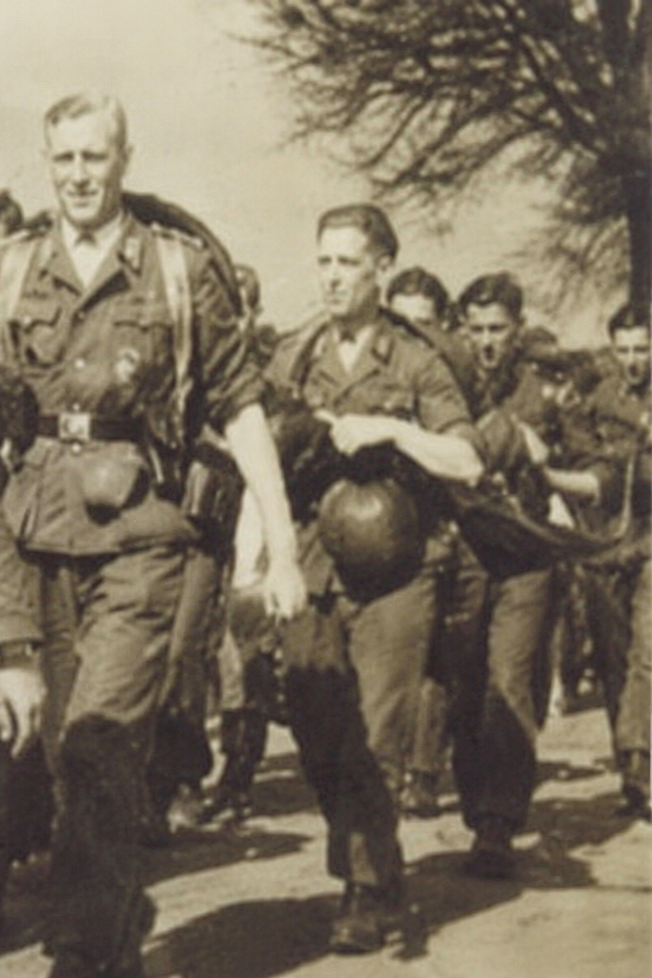
C. F. von Schalburg was the commander of Frikorps Danmark’s four companies, one headquarters company, and a pioneer platoon.
One of the four companies was equipped with infantry guns and anti-tank guns, and it was the one that was now to be deployed.
Schalburg was a splendid man, a typical Germanic warrior type and a soldier through and through.
At that time he was about 36 years old and held the rank of Sturmbannführer in the Waffen SS (equivalent to a Danish major).
Schalburg was also a very capable soldier, but just as strict as a superior officer.
Nevertheless, we liked him and had great respect for him, because he had already spent a long time at the front and had received many decorations.
In addition, one heard of the many heroic deeds he had carried out, and this was no empty talk.
Schalburg was a hard but fair leader, and he never spared himself; on the contrary, he was always at the front, and it was there that he later met a heroic death in the desolate swamps of northern Russia.
As commander of II Company (to which I belonged) we had the 22-year-old Obersturmführer Boy-Hansen (German).
He was the finest and most noble German type I have ever seen, and a wonderfully intelligent, capable, and gifted man.
We were very fond of him and looked up to him as the perfect example of a soldier.
He had been appointed personally by Reichsführer SS Himmler during a visit which Himmler made to Frikorps Danmark while we were in Treskow.
He was a well-liked and admired leader among all his men and a beloved comrade.
He was thus my commander.
I belonged to 1st group in 1st platoon, and it was said that this was the best company (II Company).
As platoon leader I had a German Unterscharführer, Oberhuber—a young, splendid, lively Tyrolean.
I shall never forget his Tyrolean dances and songs on atmospheric evenings in a comradely circle.
My group leader was an older Unterscharführer, Kling, also German. He was a soldier to his fingertips and nothing else—what one might call a very hard “dog,” but he knew his job, and this, combined with his often extremely strict discipline, helped form a strong and enduring group.
I was the first machine gunner in the group, operating one of its machine guns (MG), and the energetic Preben Overgaard handled the other.
Mads Madsen Christensen from Southern Jutland was the deputy commander of the group. He was a splendid, brave, and capable farmer, and not afraid to take the lead himself. He was also an idealist through and through.
In total, there were 11 men in our group, and almost all of them were strong and capable soldiers.
One thing troubled me deeply now that we were about to go to the front, and that was that I had to leave without my best friend and cousin Peder, who was at that time lying in a hospital in Posen.
It was truly a crack in the joy of going forward, because we had always been together, right from our school days back home in our dear —-, and I can safely say that he was the best friend I ever had, and I believe he felt the same way.
It was a great blow to me to lose you, whom I held so dear. Honoured be your memory, my dearest friend.
We often said to each other at the front that if one of us should fall, the other would go with him; we could not bear the thought of one returning home with the news that the other had fallen.
Yes—now we were finally about to go out and show what we could do, and I think most of us were glad, though a little nervous.
It is not a simple matter to set out into a war where all kinds of devilry are used to kill one another, but it was exciting.
Toward morning we finally finished packing and had a bite to eat.
Then the wagons were brought forward and loaded. They were to drive to the railway in Posen, and we said farewell to the old monastery, the river, the manor house, and the many other memorable places in Treskow to which we had become attached.
There were bad memories, but they were forgotten, and now we only had good ones left—and there were many of them.