
It was now dusk, and we could not see very much, but it was easy to see that we were now out in the outer combat zones.
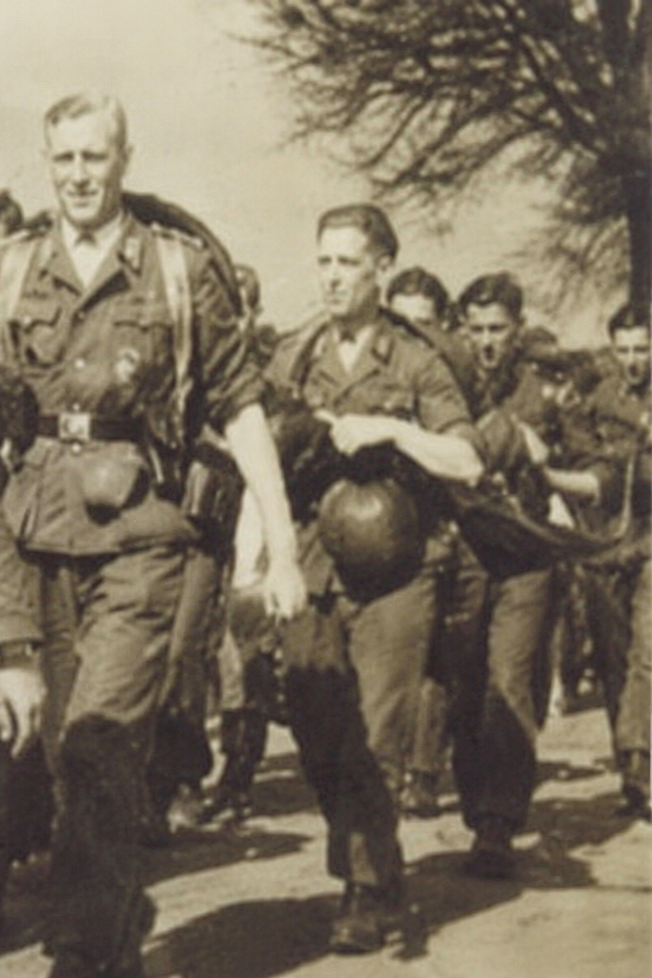
All the stiff soldierly bearing had disappeared among the ragged and weather-beaten soldiers passing by, who looked curiously at us, the pink and freshly washed newcomers.
Wrecks of destroyed wagons, cars, houses, and much else lay scattered everywhere. Bomb craters like small lakes were also visible all around.
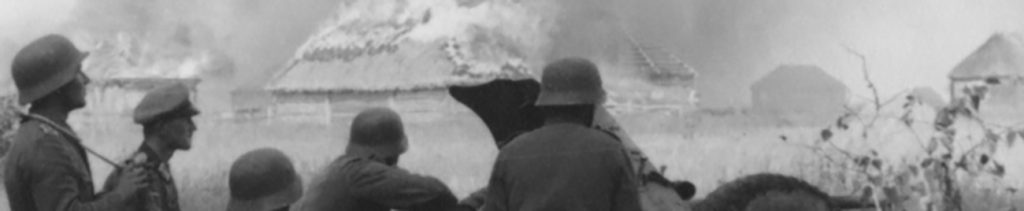
Smoke rose in long black columns from the ground, and upon closer inspection it turned out to be quite decent human dwellings underneath.
They were bunkers that provided protection against bombs and gunfire.
For us, who were used to going into a house and a bed to sleep at night, this was where the first cold, brutal, and desolate shock of the front began to appear.
Tired and exhausted, we could see no possible way to rest.
On the contrary, everywhere we looked there was only emptiness and darkness.
After sitting for half an hour, dull and exhausted on our packs, we were called together and moved in among some trees.
Here a row of lorries rolled up, into which we climbed with our heavy equipment, and here I received my next impression of the front.
The vehicles were all new Mercedes or Opel trucks, but what a condition they were in.
They were dented and battered everywhere, their windows smashed.
There were holes from shell splinters and bullets all over them, so they looked like sieves.
When they set off, they rattled and creaked like a harvest wagon on a gravel road.
But they still ran; there was apparently nothing wrong with the engines, for they made their way along the almost impassable roads at good speed.
My praise for them is due first and foremost to the drivers. I had to admire them.
They were ragged, bearded, and unkempt soldiers, but they were also accustomed to a bit of everything and remained calm in any situation.
They were soldiers from the famous Totenkopf Division, one of the oldest SS divisions, which had fought its way all the way from the Polish border to this forward outpost in the East, and had just survived the terrible winter of 1941–42 in the “cauldron” (as the encircled area was called).
It had been a dreadful winter, with hunger, cold, and life-and-death fighting, but the small group of steadfast soldiers had held out against the great superior force.
These drivers now drove us in pitch darkness, without lights, about 75 km along terrible roads—if one can even call them roads—and yet, by some miracle, we kept moving forward.
Still exhausted and miserable, we continued rumbling through the darkness along the almost impassable roads.
The terrain was, as in most places in northern Russia, vast stretches of forest and swamp, all wild and desolate.
In some places, dark and decaying huts stood by the roadside, and many German machine-gun posts were positioned along the route as protection against partisans.
Finally, after nearly two hours of driving, we stopped in a small village which later turned out to be called Losnizy.
We were now only a few kilometres from the outer front line.
We were unloaded onto the road, all in complete darkness, for fear of enemy aircraft.
What confusion it was for us, who were used to moving everywhere in light, but we later learned that darkness is wonderfully protective and easy to move in once one becomes accustomed to it.
We now looked forward immensely to getting into one of the dark houses and simply sleeping, but of course we were disappointed.
We now had to march 2 kilometres (in Russia it was always said 2 km whether it was 2 or 10 km—in this case it was 5 km) to reach the place where we were to be billeted.
More dead than alive, we set off on the march with our bulky equipment on our backs, along the most excellent muddy road.
But before we reached the end of the road, too many were no longer able to carry their packs.
So we had to drop everything except weapons and food, and leave the most exhausted stragglers as guards with the equipment until the next day.
At last we reached our destination, which consisted of a few dilapidated houses far outside even the smallest trace of civilisation.
My platoon was to be quartered in the first house, which turned out to contain an old Russian woman and two young girls.
We were shown upstairs to the first floor, where there were some small rooms, but even there we had to move in darkness because no blackout had been made.
We did manage to black out one room, where there was a stove, and then the light was switched on.
The rooms were ugly and empty, worse than the most miserable farmhand’s room, but to us it was a palace, for at last we had peace and a roof over our heads.
The young girls came up smiling and kindly and offered us hot water and boiled coffee, and we had a bite to eat and some coffee, which did us good.
But it was not many minutes before the entire exhausted group lay down on the floor and slept like stones.
I woke up during the night to the sound of rumbling and crashing so violent that the house was shaking, and powerful flashes of fire lit up the room.
It was bombers dropping their payload somewhere nearby.
Then came the rattling of shell fragments hitting the roof.
It was something eerie for a new soldier with no experience of such things, but exhaustion still overcame me, and I fell asleep again.
As soon as it was light the next morning, we were roused, and it felt good to stretch our limbs after having slept on the hard floor.
A small stream flowed right past the house, and there we washed the sleep from our eyes.
In daylight everything, however, looked more pleasant, as it stood in its green spring splendour, but there was wild wilderness as far as the eye could see.
The free life at the front already began on the first day, and it made a strong impression on us, who had spent the previous year accustomed to the orderly life of the barracks.
In the morning, some comrades had managed to get hold of an old Russian with a small cart and horse, and for a few cigarettes and some bread he transported the equipment left behind during the night to our quarters.
After that, I, together with some comrades, spent the morning exploring the surrounding area, and we also found many traces of the war in the form of destroyed equipment and shell craters all around.
We were not to get much rest, however, for already in the afternoon we received orders to move back to the small Losnizy, which we had marched from the night before.
The soldier’s lot at the front is, after all, to pack and unpack and move endlessly, though we were not yet accustomed to it.
So we trudged back along the same road we had come by.
The village of Losnizy consisted of about 60–80 houses and huts, all made of wood.
We were to stay there for about ten days, to get a taste of front-line life from a distance before going into the real “hot” zone.
It was not boring there, however.
Since all the houses were occupied, we had to live in our tents until we had built some earth bunkers, but the bunker our group constructed was so muddy and full of water due to the constant rain that we soon moved back into the tents again.
The battalion Frikorps Danmark was now subordinated to the SS Totenkopf Division as a fully motorized combat group with attached heavy weapons.
Here in the town we received our first task as fighting soldiers, as we took over the guard duty of the entire town all the way around, which was quite important, since an endless stretch of forest lay immediately adjacent to the town.
We were to occupy the trenches around the town as security troops and carry out reconnaissance patrols deep into the endless forest areas stretching south and east of the town.
Large forces of partisans were operating in these forests.
The town was under constant threat of being attacked, and it was important to prevent this, as this village—like all others just behind the main battle line—contained numerous facilities vital to the fighting troops at the front, such as a medical station, a small field hospital, workshops, a power station, bakeries, butcheries, ammunition depots, etc.