
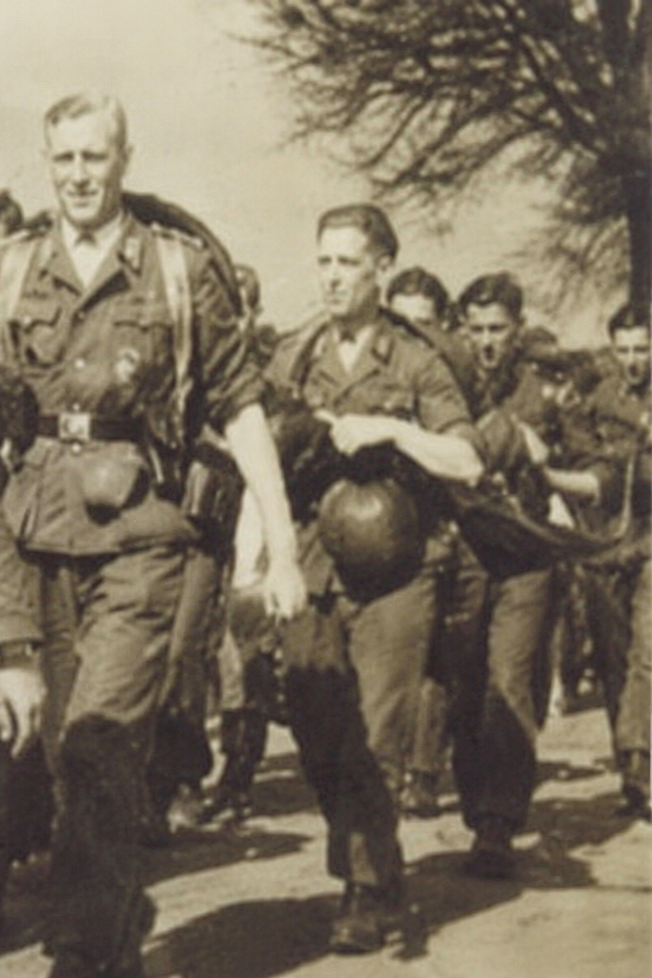
The next day at midday we boarded about 50 JU 52s, with 15 to 18 men in each aircraft. The rest were loaded with guns and motorcycles.
There was excitement and anticipation on every face as we climbed into the large black birds.
Most of us had never flown before, so it was thrilling.
In the aircraft I was in, my entire group was together, as well as Oluf (?) Hansen and a few others.
After the engines had roared for some time with an ear-splitting noise, the doors were closed.
The pilot, the radio operator, and another member of the crew took their places.
These aviators were calm, likeable, and brave men, who treated it as the most ordinary thing in the world to fly several thousand kilometres every day over the Russian lines with fresh soldiers and return with wounded from the front.
I admired these friendly and calm men very much.
Now the large, heavy “Tante Ju”, as we called the JU 52, began to taxi along the runway.
Faster and faster it went, and I don’t think I was of much use at that moment.
Suddenly it began to lift so smoothly and lightly, and when we looked out, we realized that we were already quite a distance above the ground.
We now flew a few circles around the airfield to form up with the other machines.
Immediately afterwards we went straight ahead in formation with about fifty other “aunties”. The course was now due east.
We became almost overconfident that it was not worse than this, and I suggested that we should sing a song, and soon we were singing to the drone of the engines.
But I hardly think a quarter of an hour had passed before I felt that the red wine and the good food began to perform somersaults in my stomach.
Then the singing stopped, for several others also became ill, and air sickness, like seasickness, is completely incapacitating, and so morale dropped dramatically within moments.
Before half an hour had passed, we were all sitting in a heap, with only a few exceptions, each with a gas mask case or steel helmet, vomiting—red wine—and so it went on for the next couple of hours.
It was a terrible illness; one was completely knocked out.
At first we flew high, and it was very interesting to see the ground from above.
Soon we passed over grey and ugly villages, sometimes seeing the population and German soldiers moving on the ground like small pieces on a board, but for the most part we flew over lonely, barren, uncultivated, and endless stretches of forest and swamp, so characteristic of northern Russia.
After about two hours of flying, the aircraft landed at an airfield near the city of Pskov, and we crawled out more dead than alive onto solid ground.
We got our things in order and cleaned our steel helmets and gas masks of their unpleasant contents.
I must add, for the sake of accuracy, that one of our men had left such a quantity a little distance away, and in an unnoticed moment a group of Russian prisoners of war passed by.
We heard them say “soup, soup,” and they actually proceeded to help themselves.
Do not think that they were starving; that was not the case—but more on that later.
We stayed here for about half an hour, then we were loaded again, but I never found out whether it was the same aircraft that had taken on fuel or whether they were different ones continuing the flight.
At any rate, we ended up in a different machine, and they were now equipped with machine-gunners in addition to the rest of the crew, for we were about to fly over dangerous areas—indeed over the Russian front line itself.
We now flew very low, almost at treetop level, along the River Nouvat down in the river valley.
In this way it was difficult for enemy aircraft to spot us.
Anti-aircraft guns also could not effectively engage us, since aircraft flying so low cannot be seen until they are almost overhead, and then they are gone again before one can take aim.
Our aircraft, being transport planes, apart from the occasional machine-gunner, were just as unsuited for combat as ordinary passenger planes.
My crew consisted of trained pilots who knew how to hide and slip through even the most dangerous areas.
Most of us were still ill, and it did not get better from the fact that the flight was very rough, as we went up and down over hills and valleys.
At higher altitude it was smoother and more stable, except that we would suddenly drop 10–30 metres into a pocket of air.
It was an awful sensation.
Suddenly we could see Russian soldiers running about below us, busy taking cover and trying to fire at us, but nothing happened.
Yet what thoughts ran through one’s mind—for now there was no doubt that we were to be landed on the other side of the Russian lines.
Had we flown too far?
These and many other strange thoughts raced through my head, but we were soon reassured when the aircrew told us that everything was in order.
We were now over German-held territory, although this area was completely encircled on all sides by the enemy.
We flew on for about another quarter of an hour, and then landed on an airfield—or what one might call a patch of level ground where the aircraft stood.