
It was a night at the beginning of May 1942.
I was standing guard at a lonely post in the headquarters building at Treskow, the small isolated station in the emerging Polish wilderness.
We had been stationed there with the battalion “Frikorps Danmark” for training since September 1941 and had received a very strict but good modern training in modern warfare.
Gradually, we had all become tired of sitting still there, and there was general dissatisfaction that we had not been sent to the front.
Many did not even believe that we would ever get there, but alas—we all got our wish fulfilled at a price.
Frikorps Danmark (F:D:) was thus well trained and extremely well equipped.
We had all modern light and heavy weapons, and the finest brand-new vehicles and motorcycles, and we had so many vehicles that there was one per ten men.
It was, in every respect, a unit from which one could expect the best. It was more than well equipped, both materially and in terms of manpower.
I now stood in this mild May night thinking of nothing else but that the two long hours of guard duty would finally come to an end.
Suddenly a soldier came and said that he was to relieve me, and I was surprised for several reasons.
First, my two hours were not yet over, and second, the relief did not belong to the guard detail and had no weapon.
So I would probably have held him back if he had not explained that he was from the new, not yet trained recruit company, and that they were to take over the guard duty from the battalion.
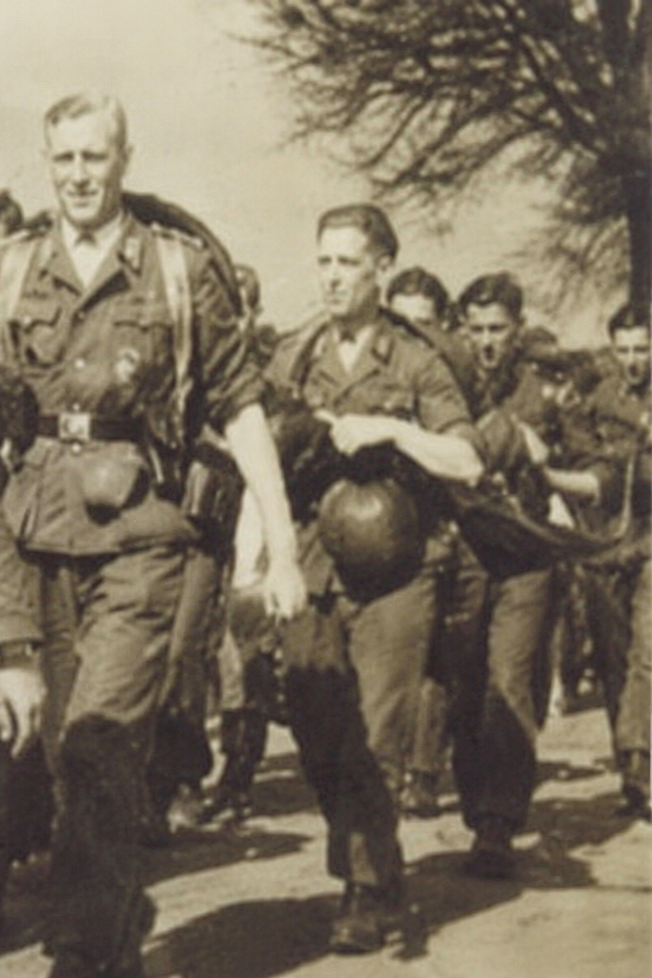
That same night, the old fully trained Frikorps Danmark had received orders to break up and, with all personnel and equipment, report to the railway station in Posen (19 km from Treskow) at 8 o’clock the next morning in order to depart by train for Russia—and thus for the front.
So I handed over my post to the man and hurried back to the guard, with a suppressed sense of nervousness, and there preparations for departure were already underway.
I quickly packed my belongings and went back to my company (II Company).
There, as everywhere else in the large barracks, there was complete confusion.
Everything had to be packed, and there was a great deal that had been collected during the long time we had been there.
Each man had to be able to carry his own equipment, along with a large amount of weapons, ammunition, and provisions.
Everything proceeded calmly and in an orderly fashion. Most men did not believe it was really about the front.
They thought it was a routine alert exercise, as we had had so many times before, which would be cancelled once we had finished packing or had marched a short distance.
But there was nevertheless something serious about this one, and gradually most of us realised that it was real when we were issued live ammunition and an amount of provisions unlike anything we had seen before.
There were whole, delicious smoked pork sides and canned goods in large piles.
Yes, there was so much that we could barely manage to carry it all, but we took it with us anyway, for we were not used to living so well—on the contrary, we were always hungry.
In addition, each man received an emergency ration consisting of two boxes of very fine chocolate, three tins of lard, and a couple of packets of crispbread.
It was only to be eaten in extreme necessity at the front, but still few actually kept it until then—we ate it on the way.
We received it only a few kilometres behind the front line in Russia; it was a tough march.