
Memoirs of former SS Rottenführer Sverri Djurhuus. Born on 11 July 1920 in Kollefjord on the Faroe Islands. Joined DNSAP on 15/1-1941, party membership no. 39109.
Sverri was, during the Winter War of 1939/40, attending a vocational school in Denmark. The entire school followed the battles in Finland, and it is said that the whole school sided with the Finns in their hopeless struggle against the Russians. However, only those who had already completed their compulsory military service were allowed to volunteer for the Danish Finland Battalion and thus assist the Finns. Sverri had not.
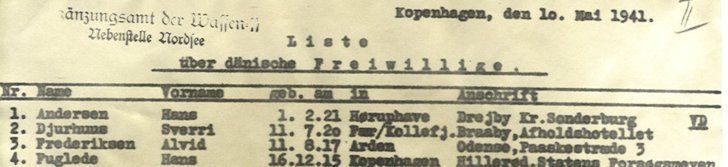
He presented himself for conscription in January for four years in the Waffen-SS, and after finishing school in March 1941, he departed on 21/5-41 for Hamburg-Langenhorn for military training.
He joined SS-St. Nordwest, 7th Company, 2nd Platoon. On 19 July 1941 he joined the newly formed volunteer SS battalion “Frikorps Danmark” as a “Hilfsausbilder” (assistant instructor) in 2nd Company, 2nd Platoon, 2nd Section as a platoon leader.
The unit was transferred on 15 September 1941 to Treskow (Poland). The wife of the Frikorps’ first commander (Kryssing) was of Faroese descent.
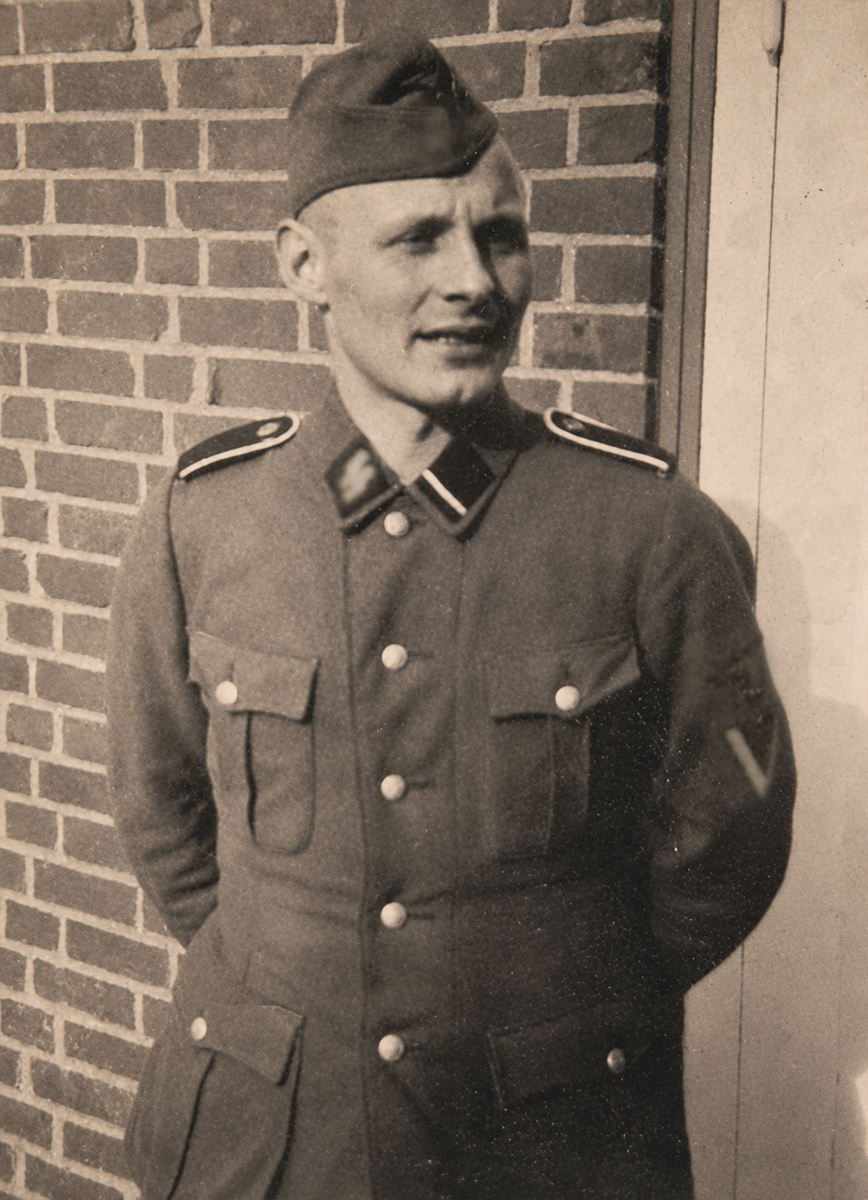
Only a few photographs of Sverri from his service period exist. Those that have been preserved were sent to his sister in Denmark during the war.
On 8–9 May 1942, as a squad leader of 2nd Platoon, he was deployed in the front sector south of Lake Ilmen in the Demyansk pocket, Russia.
He was appointed SS-Sturmmann on 21 August 1942. Only 14 days later, he had to be admitted to a military hospital in Königsberg with tuberculosis.
From there he continued his stay in military hospitals, first in Posen–Rheinbäck, where Catholic nuns served as nurses, and later he was transferred to the SS hospital in Mölln, Lauenburg.
From there he was sent to the replacement/recovery unit in Feldbach near Graz, where he served as a mail distributor and courier.
As a postal courier, he travelled several times to Copenhagen and Ringsted. During one of these trips, he met in Berlin—right in the middle of an English air raid—several Faroese volunteer Red Cross nurses (something he reportedly found quite amusing).
Sverri suffered a relapse of tuberculosis and had to return to the hospital in Mölln. In 1944 he was transferred to the field hospital on Nyelandsvej, Frederiksberg, Denmark.
At the end of the war, on 5 May 1945, he declared himself “neutral” and entered the refugee camp at “Kærhave Agricultural School” near Ringsted, Denmark, disguised as a German refugee.
In the camp, like the other refugees, he received three vaccinations against typhoid and paratyphoid fever.
Sverri still had his soldier’s book (service record) with him—but it became too dangerous. He therefore climbed up into the roof beams and hid the book there. “I thought I might be able to retrieve it later,” he explained as late as 1999.
Later he was discovered and, on 29/6/45, transferred to Ringsted Barracks (formerly the barracks of the Schalburg Corps) as a Waffen-SS soldier, prisoner no. 78.
At the District Court in Ringsted, on 31 August 1945 at 15:30, he was—under the new penal code introduced with retroactive effect (the Penal Code amendment of 1 June 1945)—sentenced to 4 years in prison and deprivation of “general trust” (voting rights and public supervision).
Sverri Djurhuus could not accept this injustice. He was too proud a man and appealed the case—but the sentence was upheld by the High Court of Eastern Denmark on 29 November 1945.
Grounds for conviction: having served in the German Waffen-SS during the period from 9 May 1941 to 1 April 1945, and for theft of 2 towels from the German field hospital in Frederiksberg, Denmark.
In Nyborg State Prison he had to spend the following period.
The political situation in Denmark changed, and the Danish SS volunteers who had been sentenced to 4 years received a reduction of their sentences to 2 years.
This also applied to Sverri.
In 1947, he returned to Tórshavn in the Faroe Islands.
In the first years after the war, Sverri worked as a taxi driver, later as a mechanic, and from 1958 he opened his own workshop.
In 1970 he had an accident that forced him to give up his profession as a mechanic, but fortunately he was able to return to his old occupation as a taxi driver, which he continued until retirement.
Sverri has appeared several times in books and on the radio, where he spoke about his service, why he volunteered, and what he experienced.
For a long time, only four volunteers from the Faroe Islands were mentioned (Sverri Djurhuus, Richard Joensen, Johannes Toftum, Leivur Restorff), but in recent times a couple more names have been added: Johan Samsonsen and Jakob Berg.
One of them was described as having deserted—whereupon Sverri immediately added: “he was no Faroese.”
Sverri Djurhuus maintained a strong sense of national pride until his later years, when he also strongly supported Faroese independence.
“Photo and registration form for Sverri.”