
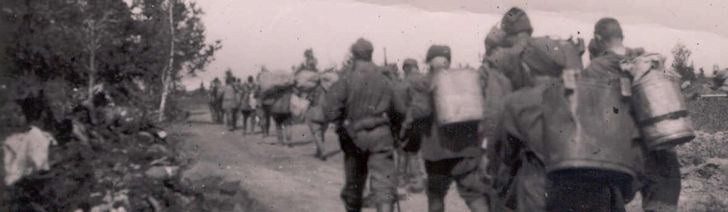
From the orphanage to Frikorps Danmark.
I have never experienced camaraderie anywhere else like the one we had in the Freikorps. We knew our duties, we knew where we belonged, and we could rely on each other.
Today, Svend Kjær lives a quiet and withdrawn life as a disability pensioner.
Svend’s parents divorced when he was eight years old, and together with a brother he was placed in an orphanage near Randers.
When the Germans occupied Denmark, Svend was 17 years old, and he tried to find work in Randers.
I had some occasional casual work with a coal merchant, but it was difficult to find anything permanent.
In 1941, Svend therefore went to Vestergade Kiosk in Randers, which served as a recruitment office for civilian work in Germany. He was offered work in the Tiergarten in Berlin, where workers were to build bunkers for the guards.
Above all, Svend would have preferred to become a soldier, but he had been exempted from conscription when he attended his military examination.
He was only permitted to stay away for six months, and therefore Svend returned to Randers after that period.
As he still could not find steady work, he once again applied for civilian work in Germany. This time Svend signed a two-year contract, but was still only granted permission to leave for six months.
(“Tævet af Gestapo” is not a complete sentence in context; it would translate literally as:)
“Beaten by the Gestapo.”
According to the contract, I was to work for two years at a locomotive factory in Vienna, but after just over half a year the Germans broke the contract.
The hourly wage was suddenly reduced from one day to the next from 1.96 marks to 85 pfennig. The 37 Danish workers at the factory were outraged by this treatment and went on strike. This led them into a serious conflict with the Gestapo.
We were beaten up by Gestapo agents, and at the same time sabotage was carried out against the factory—so of course we were blamed for it. As a result, the workers were sent to a kind of penal camp outside Vienna.
In Vienna, I had spoken with a man from Aalborg who had been in the Freikorps Danmark. He believed that the Gestapo would let us go if we enlisted in the Freikorps.
Since Svend was a kind of representative for the Danes, he saw it as his task to arrange enlistment papers for the Freikorps. He was accepted into the corps and thus escaped the Gestapo.
He was sent to Alsace and received three months of weapons training. After that, he was sent to Croatia, where it was said that we were to continue our military training. In reality, however, we had ended up in an active partisan war.
When weapons were found in a village, we were ordered to take all the men prisoner and burn the entire village down.
After Kroatien, the soldiers were transferred to Graz in Austria, where the Freikorps had a barracks.
At that time, we were merged with volunteers from other countries, and our unit was renamed Regiment Danmark.
In Austria, Svend was trained as an armoured vehicle driver and sent to the Eastern Front. The memories from there are not pleasant. He saw many who had simply frozen to death in the trenches near Leningrad.
When the major Soviet offensive came in 1944, everything began to collapse. Regiment Danmark’s supply lines broke down, and we prepared a retreat to the town of Nerva.
There, Svend was wounded and spent a year in hospital. He later returned to the corps and took part in the fighting for Berlin in the final days of the war. The soldiers reportedly wanted to hold the city until the Americans and British arrived.
It was only after the war that Svend realized the Allies had already divided Germany among themselves.
Captured by the Russians
On 11 May, most of the Freikorps soldiers were taken prisoner by the Russians. By that time, peace had long since come to Denmark, but in Germany units continued fighting until 23 May.
I came to Neubrandenburg, which was a Russian prisoner-of-war camp. It was horrible. People were dying like flies from dysentery. There were also lice, and the food consisted of soup cooked from spoiled meat.
Together with two comrades, Svend dug a hollow under the barracks, and we lived there. I was assigned to work in a Russian shoemaking workshop. The Russians quickly got used to me coming and going from the camp, so I was not searched. In this way, Svend managed to smuggle tools into the camp.
Together with the two comrades, he cut a hole in the fence and stitched it back together with thread so it could not be seen.
And then we did something that was actually very unpleasant. Many were on the verge of going insane from being in the camp. One man in particular had completely lost his mind. He just wanted out and constantly threatened the guards with escape.
I gave him my tools and showed him a place in the fence where he could cut a hole. He immediately ran off, and the Russians shot him. We knew very well that they would.
And since it was evening, under cover of darkness, we were able to slip away to our hole and escape.
Svend came into contact with the British and was sent to an internment camp for volunteer soldiers who had fought on the German side.
A Danish commission visited the camp and promised that the Danes would be sent home and treated well. Instead, everyone was met with a prison sentence.
Humiliated by the Danes
When Svend arrived in Denmark, the police and the resistance movement were waiting. But it was not the welcome he had been promised in the internment camp. The officers mocked us and tore off our insignia. We were in fact in need of some relief after the horrors of the Eastern Front—instead we were spat at.
Svend was transferred to the courthouse in Randers. Here I clearly felt the hatred towards me because I had served in the Freikorps. There was especially one episode that made me very sad and which I still do not understand.
The evening meal consisted of a portion of porridge. Other prisoners distributed the food from large carts. One evening there was a large lump of mucus on top of my porridge.
He was soon transferred to Thorsgade Barracks. Conditions were no better here. The guards treated us like rats. They were always heavily armed, and the doors were always locked.
In March 1946, Svend was sentenced to one and a half years in prison and deprived of his civil rights for five years. The verdict also stated that Svend was to perform hard physical labour.
The sentences had already been decided in advance. In my case, there was no investigation at all, Svend says.
He does not believe there should have been any post-war legal reckoning. It all seemed meaningless. Many of us had completely innocent motives when we began working for the Germans. And moreover, both the guards and many of the employers had been encouraged by the government. It had also accepted the creation of Frikorps Danmark…
Svend served his sentence in a camp near Silkeborg. The work was extremely hard. From 7 a.m. to 4 p.m. we hammered with sledgehammers on large ammunition bunkers. They were to be broken up and buried in the ground.
No consideration was given to whether one was injured or unwell. On the contrary. If we said even a single word about not being treated like human beings, the guard replied: “Who has ever said that you are entitled to be treated as human beings?”
For Svend, the Freikorps became the place where he experienced, for the first time in his life, a sense of camaraderie and belonging.
In Denmark he had lost all contact with his siblings and only had the orphanage to return to. I went there when I was released and applied for help, including finding work. But I quickly left again. I could sense that I was not welcome. The head of the orphanage did not like “my kind.”
I had nowhere else to go.
Source: Ebbe Holman: Forræder, pages 27–33.