
Svend Arne Larsen was born on 10/09/1921 as the son of “Lis Lars” (Lars Peter Gregers Larsen) and Marianne.
Born and raised with three younger sisters at Klithuse Klit, Halvrimmen in Tranum parish, in a farming family where peat cutting was also part of everyday life.
Svend attempted to volunteer for the Winter War in Finland in 1939/40, but it ended (armistice) before he was able to depart.
Svend completed his schooling at Store Restrup agricultural school on 27 March 1940 and joined DNSAP, being registered as member no. 40103.
Shortly after, on 2 July 1941, Svend filled out a recruitment form for the Germanic Volunteers in the SS Standarte “Nordland” for the duration of the war (“Kriegsdauer”).
As Svend put it in his strong North Jutland dialect: “Why should we sign up for longer than necessary—we could not know it would drag on.”
He attended the enlistment examination on 13 July and was accepted, with departure on 16 July 1941.
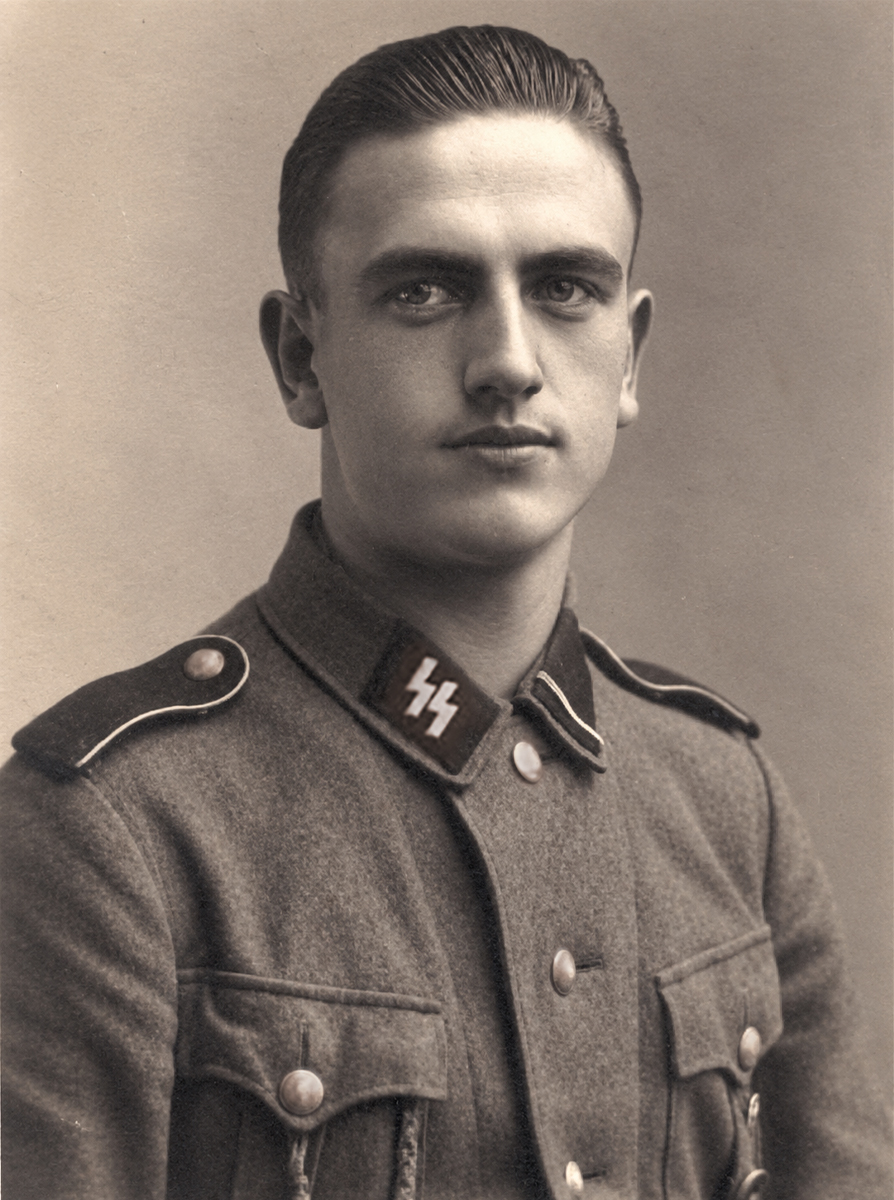
Svend is one of the very few volunteers of whom photographs exist showing three different collar tabs. (images 1–3)
He was accepted as a Danish SS volunteer in the newly formed horse-drawn Danish volunteer battalion, SS Legion Freikorps Danmark, as SS Schütze (private) No. 84 in 2nd Company.
Identification mark: 2/Freikorps Danmark – 109 –
He was trained at the barracks in Posen-Treskau from 16.9.41 to 8.5.42, after which he was transported by JU52 to the front deployment in the Demyansk pocket south of Lake Ilmen in Russia.
He was promoted to Legionary Oberschütze on 1 December 1941.
His first stop before full frontline deployment was the town of Werezniza, but only a few days later fighting broke out in the battles against the Bolsheviks in the combat area near the River Robja, as well as in the fighting for the town of Bol Dubovizy.
He was again promoted on 21.7.42, now to SS-Sturmmann.
The fighting became intense, and he was severely wounded in the left shoulder on 23/7—reportedly by a sniper, according to Svend.
He was immediately flown to the HVP (main aid station) and from there by JU52 to Field Hospital 207 in Pleskau, where he remained from 29.7 to 15.8.42.
On 1.8.42, Svend was awarded the Verwundetenabzeichen in Schwarz (Wound Badge, 1st class for the wounded).
He was transferred by hospital train to the reserve hospital in Baden-Baden, Hotel Landesbad, where he stayed from 2.9 to 31.10.42.
From there he returned for convalescent training at SS Panzergrenadier Replacement Battalion 11, Graz-Wetzelsdorf, but shortly afterwards, on 2.6.43, he had to be transferred to SS Lazarett Detachment 20/a, Traunstein 13B, Upper Bavaria.
When he was again reasonably fit, he was moved for further training to the Replacement Training Company in Brobruisk.
After having problems with his wound, he was transferred to the convalescent hospital in Ruhpolding in January/February 1944, but shortly afterwards he was moved to the General Company of Freikorps Danmark in Breslau and further in May 1944 to the troop training unit in Feldbach in Styria, where he was accepted into the General Company of SS Panzergrenadier Replacement Battalion 11, Feldbach.
After a period of leave, Svend was again fit for combat (“kriegsfähig”) and was sent to the 11th SS Panzergrenadier Division “Nordland”, Regiment 24 “Danmark”, 7th Company, and entered into the service record with Stammnr. 272.
On 8.9.44 he was awarded the Infantry Assault Badge (“Infanterie-Sturmabzeichen”).
He was wounded on 10.9 in the right forearm by a shell fragment and had to be transferred to the hospital in Reval (Tallinn). From there he was moved via Gdynia to the reserve hospital Spindelmühle, Czechoslovakia (arriving 23.9.44 by hospital train).
He went on leave on 13.10.44 in order to get married to Elly Krog Petersen.
Svend proudly received the “Verwundetenabzeichen in Silver” (wound badge, 2nd class) on 19.10.44.
From the hospital in Oberndorf near Salzburg, he was granted sick leave and discharged on 26.2.45 in order to travel to Denmark. The leave was valid from 1 to 25 March 1945.
Svend arranged to be granted “Sonderurlaub” – an additional leave to Denmark, which meant that he was in Denmark during the final days of May 1945.
On 8 May 1945 he was taken from his parental farm by local resistance fighters—he was to be imprisoned.
To this day, Svend does not understand why. “I do not believe I have done anything wrong,” he stated, referring to the fact that Danish volunteers were encouraged by the government to go and fight against the perceived threat of communism advancing into Europe.
On 25 September 1945 he was sentenced to 3 years in prison and deprived of general trust for 5 years.
As the political climate and hostility in Denmark subsided, Svend was also granted a pardon on 5 October 1946 in the form of a sentence reduction.
Svend Arne Larsen was active in veterans’ comradeship associations in Europe in the years after the war and received the following distinctions:
“Golden Ulrichsberg Honour Badge”
“Certificate of Honour and Gold Pin of the Korps Steiner”
“Golden HIAG Cross”
In 1999, he was nominated to receive the “Narwa Cross” from the Estonian freedom fighters’ and veterans’ association, which he was also awarded in recognition of his service both at the front and in post-war comradeship activities.
In Denmark, he received the “Badge of Honour” from the Association of 2 July 1978, as well as the pin of “Mindelunden” (the Memorial Park).
Svend has been particularly active in veterans’ circles since its establishment in 1972, and for many years he has been responsible for the veterans’ association “Fællesskabets Mindelund of 1969”, known as “Mindelunden”.
He has participated in discussions about his wartime service and appeared, among other things, in several radio programmes in 1976 and in the 1998 television broadcast “Dobbelt forræderi”.
From the period of convalescent rehabilitation at the hospital in Traunstein, 1943/44. (images 4–6)
Here Svend is seen as most people remember him: an older but still fit elderly man, shaped by a long and hard life, yet full of experiences. (images 7–9)
Pages from the SS service record / soldier’s book. (images 10–12)
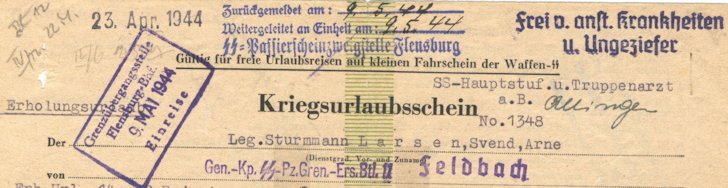
Documents from his period of service. A/ When Svend was wounded in the arm, he was issued a document stating that he was exempt from the duty to salute. In connection with his discharge, Svend, having become good friends with the office staff, arranged a forged “Urlaubsschein” (leave travel document). (images 13–16)