
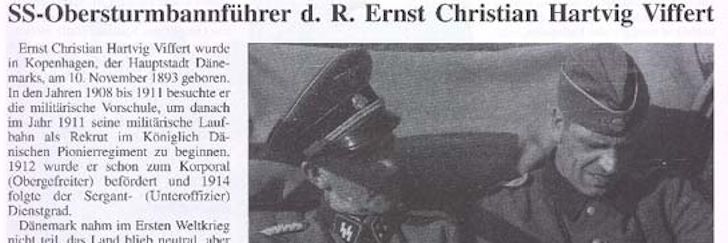
Article from the German military magazine “Der Freiwillige”, written by H. T. Nielsen.
Translation of image 1.
SS-Obersturmbannführer (reserve) Ernst Christian Hartvig Viffert
Ernst Christian Hartvig Viffert was born in Copenhagen, the capital of Denmark, on 10 November 1893.
In the years 1908 to 1911, he attended the military preparatory school and then began his military career in 1911 as a recruit in the Royal Danish Engineer Regiment.
In 1912 he was already promoted to corporal (senior corporal), and in 1914 he received the rank of sergeant (non-commissioned officer) in active service.
Denmark did not participate in the First World War; the country remained neutral but kept its army combat-ready.
Non-commissioned officer Viffert attended the officers’ school during this period and was promoted to lieutenant on 21 October 1921.
In the years 1923 to 1926, Lieutenant Viffert was trained at the Pioneer Officers’ School and subsequently completed his training as an officer in the army before travelling to the Far East.
In Asia, he worked as a railway engineer, where his expertise—particularly in bridge construction—was in demand.
After about three years, he returned to Denmark, where he again took up a position in the Royal Danish Army.
The unrest in Europe in the 1930s naturally also affected Denmark, and Viffert, like many of his compatriots, had to choose a side.
He therefore became active in the army again and, on 1 June 1934, was admitted to the Royal General Staff as commander of the Pioneer Battalion.
As a captain, Viffert was appointed leading officer in the King’s Pioneer Battalion.
The unrest in Europe in the 1930s naturally also affected Denmark, and Viffert, like many of his compatriots, was forced to choose a side.
He therefore became active in the army again and, on 1 June 1934, was admitted to the Royal General Staff as commander of the Pioneer Battalion.
As a captain, Viffert was appointed leading officer in the King’s Pioneer Battalion.
To avoid English and French retaliatory measures, the Royal Danish Army was disarmed but not dissolved.
It retained its colours and fought unwillingly, and only after two hours of combat was the order given to cease fighting.
Thirteen Danish soldiers and three border gendarmes had fallen in vain.
Filled with shame and disgust towards democratic politics, the now soldierless army fell into dissolution.
Viffert joined the “National Socialist Workers’ Party of Denmark” (DNSAP) on 12 June 1940. He received membership number 30,095.
This party, led by Dr. Clausen, sought to bring the truth about 9 April 1940 to light and to hold the responsible politicians accountable for their actions.
Captions for images:
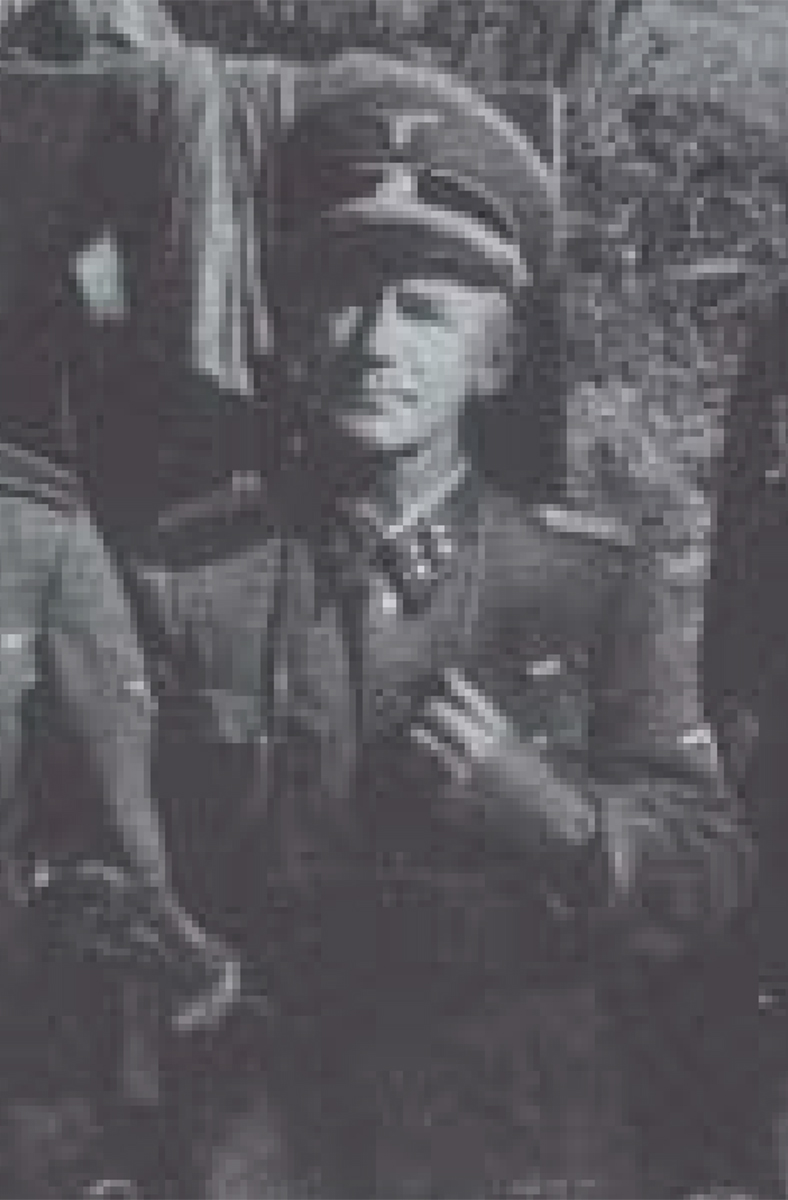
- SS-Sturmbannführer Viffert together with the orderly officer, SS-Obersturmführer Dr. Müller, spring 1942.
- Spring 1942. From left: the dentist, SS-Sturmbannführer Viffert, and his father, a Danish volunteer.
Translation of image 2.
Dr. Clausen wanted the truth about 9 April 1940 brought to light and sought to hold the responsible politicians accountable for their actions.
The army remained under arms, but morale was broken.
In public, officers were insulted by the population because they appeared not to have dared to fight on 9 April 1940.
In the following months and years, many officers resigned from active service.
On 22 June 1941 came Operation “Barbarossa”.
Four days later, the Danish government and the King’s conviction had reached the point where permission was granted to establish a volunteer battalion to fight Bolshevism in the East.
Within a few days, the first 600 volunteers signed up.
For active officers, this was not automatically permitted. However, through a letter from the Ministry of Defence in Copenhagen, permission was granted, and the Danish army even allowed its officers to fight against the common enemy.
Many participants in the war described this letter as a release. Now they could finally do what they had not been able to do on 9 April—fight for the whole population of Europe against the Asian eastern threat.
The Danish Foreign Minister Erik Scavenius, however, publicly contradicted this, but not officially, as active members of the Danish armed forces were also formally sent to the front.
Regardless of his age, Captain Viffert was among the volunteers who enlisted.
He was accepted as a Legion-Hauptsturmführer and travelled to Hamburg-Langenhorn, where the Danish battalion was established under the name “Frikorps Danmark.”
The commander was the Danish Legion Obersturmbannführer Kryssing.
Training progressed slowly, and there was considerable unrest, especially among the enlisted men. Therefore, a number of officers were brought in from outside.
Among them was Legion Hauptsturmführer Viffert, who, as a trained pioneer, was assigned to duty in the Waffen-SS.
After completing his training in Germany, Viffert was promoted in the spring of 1942 to SS-Sturmbannführer of the reserve and assigned to the SS pioneer battalion of the SS motorised division “Wiking”.
There he served as deputy battalion commander.
His experience in bridge construction in Asia now proved useful to the division and its weapons.
From 21 August 1942 to 3 October 1942, he commanded 2./SS Pioneer Battalion “Wiking”.
For this, he was awarded the Iron Cross 1st Class and the Black Wound Badge.
After further training in Germany and during the summer of 1943, he was appointed on 1 October 1943 as an SS officer in the Waffen-SS, and on 8 October 1943 he was transferred to the Waffen Army Corps of the SS (Latvian AK).
On 9 November 1943 he was promoted to SS-Obersturmbannführer of the reserve.
As part of the Waffen Army Corps for the Baltic (Latvian) volunteers, he fought in Courland and, under SS-Obergruppenführer and General of the Waffen-SS Walter Krüger, against Soviet soldiers.
Captions for images:
- Spring 1942. From left: the Danish volunteer and Finland fighter, the father of SS-Sturmbannführer Viffert; on the far right, SS-Obersturmführer Dr. Müller.
- In front of their own bunker, spring 1942. From left: an unidentified officer, SS-Sturmbannführer Viffert, SS-Untersturmführer Georg Kormann, and SS-Obersturmführer Dr. Müller.
Translation of image 3
SS-Obersturmbannführer Viffert remained in the corps’ pioneer command until the end of the war and carried out outstanding work in Courland and along the River Aa.
The Latvian Waffen SS Obersturmbannführer Oskars Petru von Korp-Stab remembered Viffert as “his old but steady point.”
When the Courland pocket was closed on 8 May 1945 at 14:00, the VI Waffen Army Corps (Latvian) laid down its weapons.
The commander chose suicide.
SS-Obersturmbannführer Viffert, together with thousands of non-German and Latvian comrades, was taken into Russian captivity.
Together with other Germanic volunteers, he was sent to the prisoner-of-war camp 7162/13 near Darnytsia south of Kyiv.
There, Viffert attempted to keep up the morale of the prisoners.
Among other things, he gave daily instruction in military history, with the main themes being the wars between Denmark and Prussia in 1848/1850 and 1864.
In the summer of 1950, he was finally brought before a war crimes tribunal in Kyiv.
As a collective war criminal without individual acts, he was sentenced to life imprisonment and an additional 25 years of forced labour.
After the verdict, he merely laughed and thanked the judge for still being allowed to live for so long.
At the end of 1950, SS-Obersturmbannführer Ernst Christian Hartvig Viffert died of illness, weakness, and malnutrition in his prison cell in Stalin.
He was called to arms by his king and his government to go to war. As always, this man fulfilled his duty until his last breath.
His honour is called loyalty.
Captions for images:
- Leaders from SS Pioneer Battalion 5 at a sports festival in Courland, spring 1943. From left: SS-Sturmbannführer Viffert, SS-Hauptsturmführer and Knight’s Cross recipient Hugo Eichhorn, SS-Obersturmführer Georg Kormann, two unidentified Obersturmführer, and SS-Untersturmführer Hille.
- SS-Sturmbannführer Viffert wearing the Knight’s Cross of the Order of the Dannebrog, spring 1943.