
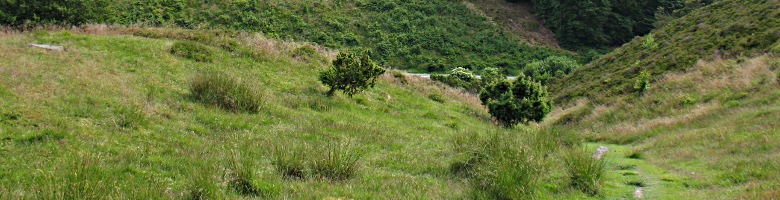
The Karawanken Mountains form the northern border between Croatia and Austria. Wild and rugged, yet magnificent and of a remarkable beauty, the dark mountain peaks rise toward the sky. Spruce and pine twist and cling from the valleys up along the steep rock faces, in an eternal struggle against the harsh forces of nature, until they finally meet their fate high under the clouds.
A wonderfully beautiful panorama passed before our astonished eyes—things we had heard about, read about, and seen in pictures, we were now experiencing in reality. The settlements were sparse and scattered; here and there small villages lay hidden in the deep valleys.
It was an ideal landscape for partisans and insurgent elements, but since it was partly outside Marshal Tito’s sphere of influence, security was reasonably good.
Over Marburg we reached Agram, or Zagreb, as the city is called in Croatian. Agram has around a few hundred thousand inhabitants, is the capital of Croatia, and was the seat of the government at that time.
The terrain had gradually changed, and from Agram we steamed out onto the wide plains that stretch for mile after mile on both sides of the Danube’s major tributary, the Sava. Here, the partisans’ area of activity truly began.
In front of the locomotive we had four freight wagons filled with gravel; their task was to absorb the first impact of any explosive charges that might have been laid, and at the same time give the engine driver a chance to stop the slowly moving train.
The forests had been cut down or burned at a suitable distance from the railway line to prevent sudden attacks. Many of the small stations bore signs of partisan activity, destroyed and ravaged by fire, all surrounded by barbed wire and occupied by Croatian troops.
The first major town after Agram was Sisak. In Sisak we were shunted onto a siding and continued on to our first destination, Petrinja. A part of the regiment had been stationed in Sisak; most of the 2nd battalion was quartered in Petrinja, while the 1st battalion continued on to the town of Glina, deep in the mountains.
Petrinja: The barracks, or rather the barack camp, were located on the outskirts of Petrinja and naturally as far from the railway station as possible.
Our legs were quite stiff after a week-long confinement in the cramped, shrinking freight wagons—it became a hard march in the scorching midday heat, made worse by our heavy packs and thick clothing.
By Danish standards, it is very hot in Croatia. Day after day the sun burned from a cloudless sky, and the fresh winds of home were an unknown concept here. It was torture to drill in the heavy soldier’s uniform; the slightest movement made sweat pour from every pore, and we blessed the regimental command when the order came that shirt, belt, and trousers were to be regarded as the only prescribed clothing.
Petrinja has a quite beautiful location at the transition between plains and mountain ranges. To the east and north, the great valleys stretched out where fields of maize waved and cattle and pigs grazed in herds. To the west and south, the first foothills of the vast mountain region of Serbia and Dalmatia rose from the plain, their forested peaks standing out, while the fresh, wide stream of the Kupa River flowed at their base.
Petrinja had about 10,000 inhabitants and was the center of a large surrounding area. Farmers and highlanders brought their many different goods to the town and bartered through extensive exchange for other necessities. Money had little or no value, as inflation was rampant throughout the country.
When Lieutenant J… or Corporal P… became thirsty—as one often does in Croatia—and wanted to add some flavour to the country’s excellent wine, the soldier’s pay did not go far. But if he was fortunate enough to possess private belongings that could be sold on the black market, the situation was quite different.
It was astonishing how many kuna (Croatian currency, corresponding to Danish kroner) a watch or an old shirt could bring in. One felt like a true Croesus when a thick bundle of large banknotes was paid out, yet the disappointment was all the greater when one realised how little could actually be bought with the money.
Alcohol was not the most expensive item: a bottle of good rum could be bought for 800 kuna, whereas a pair of good boots—if they were even available—could cost as much as 40,000 kuna.
Few managed to leave Croatia with their personal belongings intact; everything was converted into alcohol. Had it been possible to sell army property, the men of Regiment Danmark would ultimately have been left wearing nothing but a sparse loincloth.
Some had already begun selling blankets and other parts of their equipment, items they considered completely unnecessary in the hot climate. This view was not shared by the military authorities, who could not see the usefulness of simplifying equipment. A strict and resolute stop was put to this trade.
In minor cases, for example when it only concerned a blanket, the punishment was demotion and imprisonment; in more serious cases, transfer to a penal battalion, which was almost equivalent to a death sentence.
The Italian troops, who had occupied the country before we arrived, carried out a far more extensive barter trade, and the partisans were their good customers, for a good Fiat armoured car the price was 5 cows.
Petrinja was quite an amusing town, very different from a Danish provincial town of similar size. Several buildings were beautiful and monumental, but everywhere there was a sense of decay and a lack of order, which suggested a certain ease or indolence among the population.
It was quite a spectacle when, in the evenings, the farmers drove their roaring herds of cattle through the streets—a scene completely unfamiliar to us.
Taverns were plentiful, and there was an abundance of wine and spirits, but there was no real entertainment life. The women were beautiful and neatly dressed, whether in modern clothing or in the floral Croatian national costume with its many layers of shirts.
The men were their complete opposite. Here—as everywhere in the Balkans where I have been—they were small, dark, and poorly built. It must, for fairness’ sake, be added that the military had taken possession of the best part of the youth.
The civilian men’s clothing was rather ragged, clearly showing the shortage of textiles; I do not remember having seen a proper suit of clothes down here.
In the two larger towns, Petrinja and Sisak, where we were stationed, the population’s attitude toward the Germans was friendly but reserved—the girls, however, excepted; the occupying forces were regarded as a necessary evil.
The partisans operated actively in the area around Petrinja; it was especially in the mountains to the west, on the connecting road to Glina, that they were active, but even the road to Sisak was not safe. Several of our supply convoys had been attacked and a number of men killed.