
Article from the German military magazine “Der Freiwillige”, written by H. T. Nielsen.
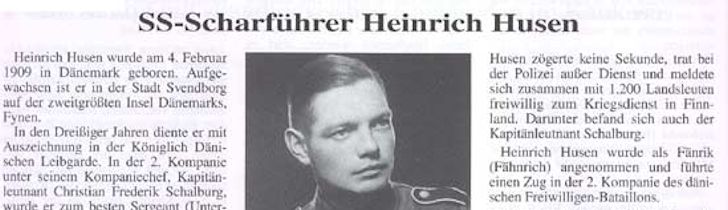
(translation of image 1)
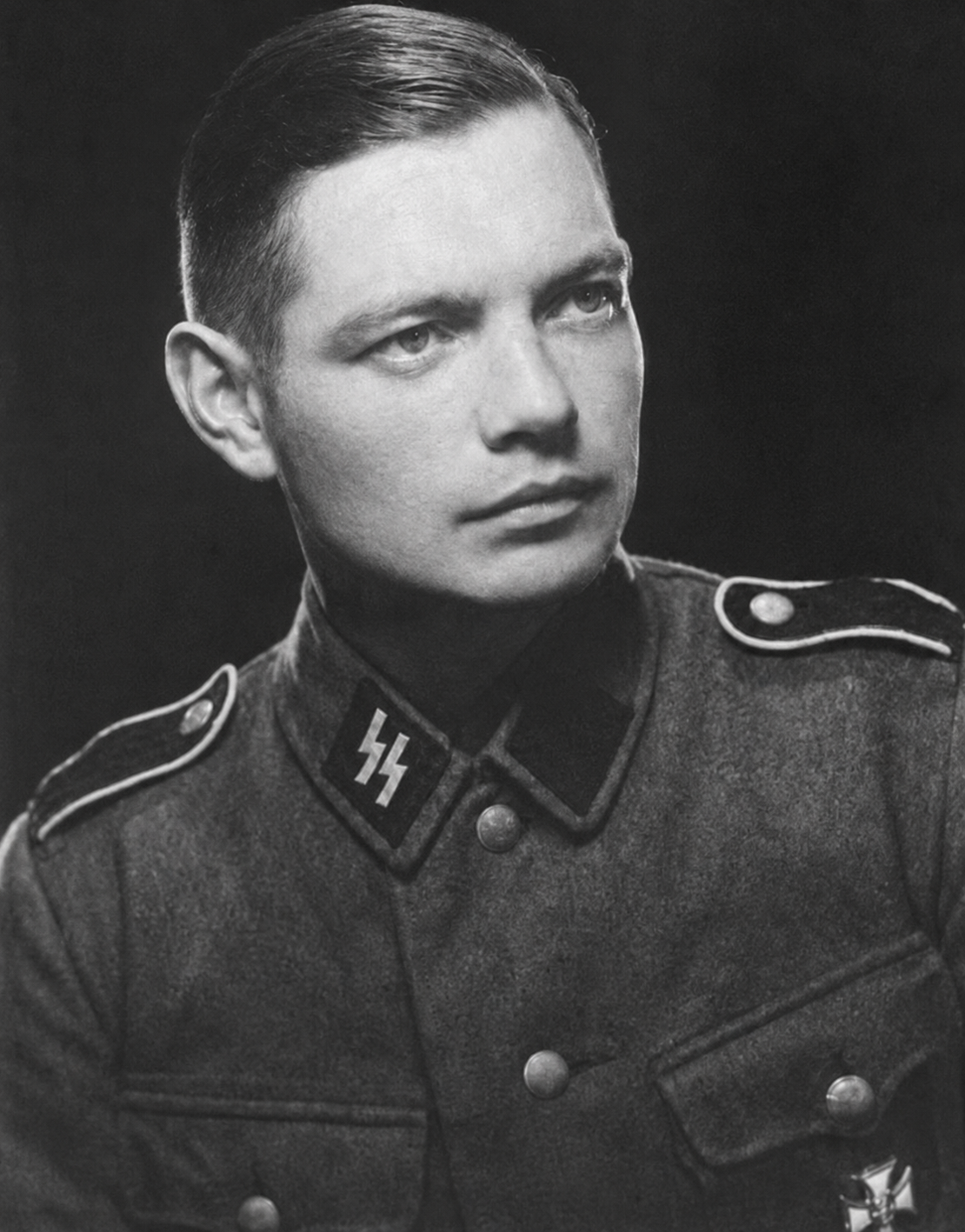
Heinrich Husen was born on 4 February 1909 in Denmark. He grew up in the town of Svendborg on Funen, Denmark’s second-largest island.
During the 1930s, he served with distinction in the Royal Danish Life Guards.
In the 2nd Company, under his company commander, Captain-Lieutenant Christian Frederik von Schalburg, he was promoted to a non-commissioned officer of the highest calibre.
After completing his military service, Heinrich Husen returned to the Danish police force and, in the following years, was promoted to police officer, carrying out exemplary and impeccable service in his hometown of Svendborg.
During this period, he was also a member of the Danish National Socialist Workers’ Party (DNSAP) under Dr. Frits Clausen.
His former company commander was at that time the leader of the National Socialist Youth (NSU), the youth movement affiliated with Dr. Clausen, and it was therefore natural for Heinrich Husen to devote himself to youth work in his native region of Denmark.
With great enthusiasm, the NSU youth of Svendborg followed their new Bannführer (district youth leader).
Then war came to Europe.
On 30 November 1939, the mighty Soviet Union attacked the small Nordic state of Finland.
Heinrich Husen did not hesitate for a second. He resigned from the police force in Odense and, together with 1,200 of his fellow countrymen, volunteered for military service in Finland.
He continued to serve there even after the capitulation.
Heinrich Husen was commissioned as an ensign (Fänrik) and commanded a platoon in the 2nd Company of the Danish Volunteer Battalion.
On 13 March 1940, the peace treaty was signed. Finland was forced to cede part of its territory but succeeded in preserving its independence.
For his services, Ensign Heinrich Husen was awarded the Cross of Liberty (with swords), the Murtotalj Medal with the clasp “Heimatfront” (“Home Front”), and the Finnish Cross of Liberty.
Back on Funen, Heinrich Husen no longer found his way back into the police force.
For a short period, he worked on the construction of a small airfield near Sæby.
Germany had now occupied Denmark, and Husen believed that the struggle for Europe had begun. He wanted to take part in it.
Like many of his former NSU youths, he travelled in strict secrecy to Klagenfurt, where he was trained as a non-commissioned officer in the 1st Regiment of the newly established “Nordland” (Motorized Division).
His former commander, now SS-Hauptsturmführer Christian Frederik von Schalburg, was also serving there as an officer.
At the age of 31, Heinrich Husen also volunteered for service.
In doing so, he wished to restore Denmark’s honour and, if necessary, once again take up arms against Bolshevism.
He is also said to have declared:
“There will not be many European people left on our earth. The only way to preserve peace, order, and justice is through war. The time when Germanic peoples fight one another must, with this war, be over forever.”
Because of his training in the Danish Army and his experience from Finland, …
(Translation of image 2)
Because of his training in the Danish Army and the experience he had gained in Finland, Heinrich Husen was promoted to SS-Scharführer in the spring of 1941 and served as a squad leader in “Nordland.”
At Heuberg, “Nordland” was incorporated into the newly formed SS Division (Motorized) “Wiking,” and shortly thereafter came 22 June 1941, the beginning of the German invasion of the Soviet Union.
With the fighting came the first casualties.
On 20 July 1941, the first Dane to be killed in action fell: SS man Gunnar Christiansen of 7th Company, “Nordland.” He had been born in Odense on 7 January 1922.
As early as 2 August 1941, SS-Scharführer Heinrich Husen was killed in action.
He was soon followed by SS man Ernst Bredal Jepsen of II./“Nordland”, who had been born on 30 December 1918 and was killed on 8 August 1941.
Over the next four years, nearly 4,000 Danish compatriots would follow them on the road to Valhalla.
On 4 August 1941, the death notices for SS-Scharführer Heinrich Husen appeared in the Danish newspapers.
They were signed “SS-Hauptsturmführer Christian Frederik von Schalburg, in the field.”
The old comradeship in arms from the Royal Danish Life Guards and from Finland had not been forgotten by him.
On 3 May 1942, SS-Sturmbannführer Christian Frederik von Schalburg, now commander of Frikorps Danmark, delivered an impressive speech at a large gathering in KB Hallen in Copenhagen.
Among the audience, he recognized an elderly couple. They were Mr. and Mrs. Husen.
He personally approached them, expressed his condolences, and assured them that their son had fought and fallen as a true Germanic warrior.
In Heinrich Husen’s actions, one could recognize the old virtues of the 2nd Company of the Royal Danish Life Guards.
NSU Hird Leader (Gefolgschaftsführer) Ellev Henry Rasmussen of Svendborg. One of Heinrich Husen’s boys.
As early as 24 May 1940, Rasmussen, only 17 years old, secretly volunteered and travelled to Klagenfurt.
He served as deputy squad leader in SS-Scharführer Husen’s squad in 1./“Nordland” and was standing close beside him when Husen was killed by a gunshot to the head.
In 1944, SS-Untersturmführer Rasmussen was serving as battalion adjutant in III./“Danmark”, and in the final stages of the war he became a battle group commander during the fighting for Berlin.