
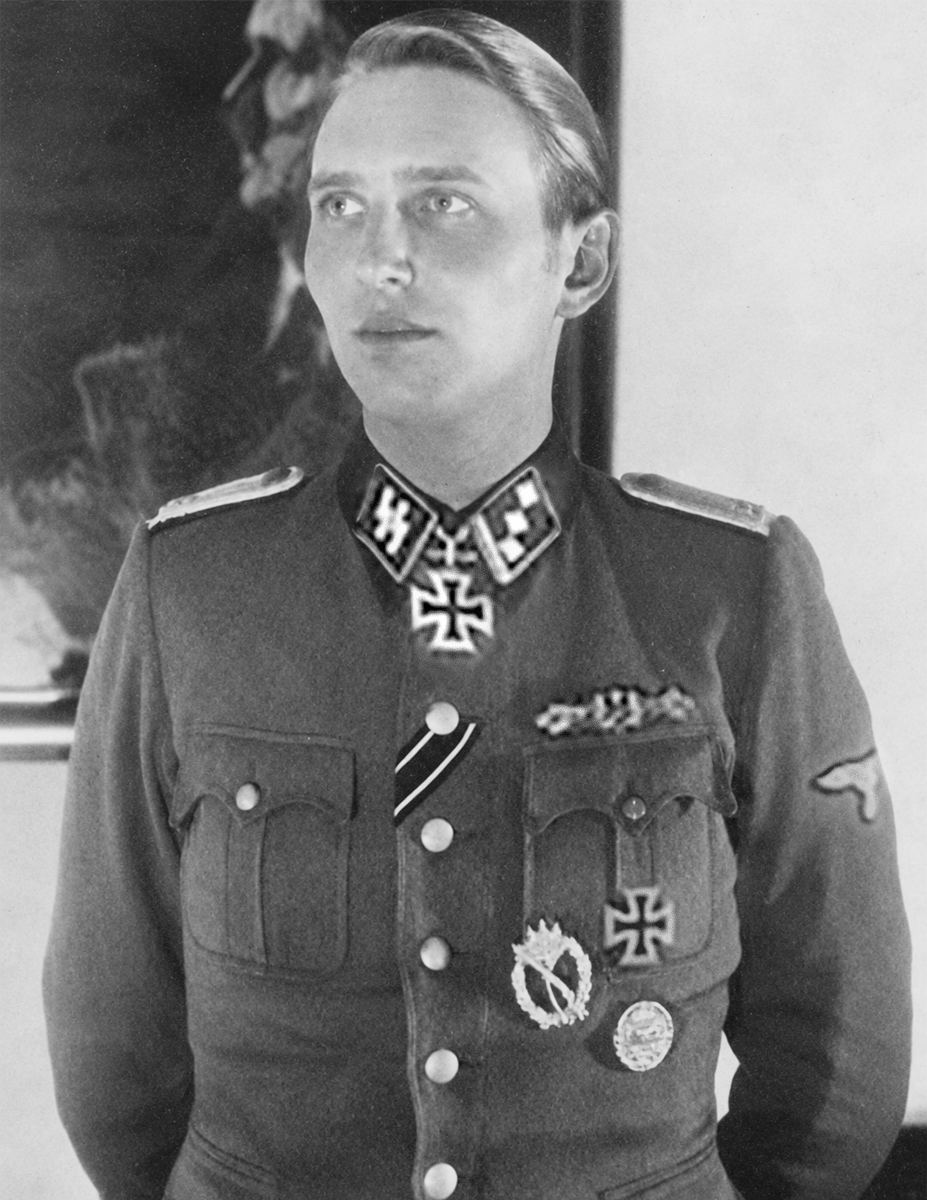
Søren Kam, born 02 November 1921 in Copenhagen, began his service on 20 May 1940 with 1st Battalion / Regiment “Nordland”.
In late October 1944, the Eastern Front had shrunk and now ran lengthwise through what is today Poland. Along the Bug River northeast of Warsaw, the SS Division Wiking’s Regiment Germania was attempting to hold its positions.
After the failed attempt at a breakthrough, the Russians now concentrated their forces at the mouth of the Bug River, the so-called “wet triangle,” where the Narew and Bug rivers flow into the Vistula.
Regiment Germania was moved to a new sector in this area, and I Battalion was ordered to take up positions with its left flank on the river and hold the line.
The front line ran at a right angle to the river, extending inland. On the opposite bank, the ground rose into a steep, towering escarpment. Up there on the far side of the river lay our comrades from the other division.
We found a well-developed trench system left behind from earlier fighting.
We were aware that the enemy could attack either frontally or along the river. But everything in front of us was still completely quiet, so I took my “Schützenpanzerwagen” (armoured personnel carrier) and drove out into no-man’s-land to observe the terrain ahead of us.
After a while I noticed movement in a forest about one kilometre ahead of me. I gave my driver the order to drive to a solitary house on a hill with a good view.
I crawled forward along the house while sending my armoured personnel carrier back down the slope behind it.
Suddenly the air was torn apart by a tremendous explosion, and I felt a powerful blow to my back that threw me to the ground.
I første øjeblik mente jeg, at jeg var blevet såret. Jeg mavede mig bag huset i dækning og tog min frakke af. En knivskarp granatsplint affyret af en af de berygtede ”ratsch-bumm” kanoner havde skåret min lammeskindsforede frakke igennem som med et barberblad i en længde af 15 centimeter.
But I had escaped unharmed.
The high-explosive shell had been fired by a Russian anti-tank gun, which was also used against infantry. We called it “ratsch-bumm” because the firing, “ratsch,” and the impact, “bumm,” followed almost immediately one after the other.
The Russians sent a few “well-intended” greetings over to us, and it was only with difficulty and through a very courageous effort by my driver that we managed to get back unharmed.
We were aware that it would not be long before they appeared in front of our sector.
During the night, hell broke loose on the other side of the river, and from our positions down by the river we witnessed a desperate battle that our comrades were fighting on the far bank.
They were pushed back during the night, so that by morning we established that the Russians were now our neighbors on the opposite riverbank.
As mentioned, the opposite riverbank lay much higher, and we were now in an extremely difficult situation. The Russians were able to observe our positions to a considerable extent.
Through my binoculars, I could see exactly how high-ranking Russian officers, easily recognizable by the red insignia on their coats, appeared and observed our sector of the front. And it did not take long before we received the first warning from the opposite riverbank in the form of “ratsch-bumm” shelling.
The entire day we were under artillery fire, and then I received orders to report to my battalion commander, SS-Hauptsturmführer Martin Kruse.
When I entered his command post, I saw that one of his legs was bandaged. He had been hit by a shell fragment and had to be taken to the dressing station.
His order was short and precise: “Kam, you take over the battalion.”
From that moment, the entire responsibility for this important sector rested on my shoulders. I admit that I was not particularly pleased, for I was now the only officer left in the battalion.
All four companies together numbered a little more than 100 men.
Night fell, and it was relatively quiet. I was constantly on the move, encouraging my men and staring into the darkness for signs of enemy movement.
At around three o’clock, I had just returned, exhausted, to rest for an hour in my bunker when the enemy artillery began pounding our positions. I rushed back to our trenches and could hardly believe my own eyes when I suddenly saw a number of my men, mostly the new recruits, running back.
They had completely lost their nerve during this first baptism of fire. It took all my efforts to get them to return to their abandoned positions, and I was risking my life as I walked above ground outside the trenches to show them that it was not all that dangerous.
Meanwhile, it was beginning to get light—the ideal time for a Russian attack. The shelling was the prelude to a fierce infantry assault, and although we defended ourselves bravely, the Russians succeeded in breaking into our positions and occupying a section of our trench.
In this sector there was a hill designated “86,” which was of particular importance because it provided a view over the entire surrounding landscape. It was my task, under all circumstances, to keep it occupied, but the Russians succeeded in capturing this position.
I gathered all the men who were in the immediate vicinity, and then my counterattack came suddenly and without delay. We succeeded in taking the hill back into our hands.
It was not long before the Russians came again in a new wave, supported by aircraft that fired upon us.
It was a murderous battle, and once again we had to yield our positions to the fiercely fighting enemy.
During the course of the day, the sun had come out, and the sweat was pouring off me, so I had to take off my coat. In the confusion of the fighting, I had forgotten it in the trench.
Then night fell over friend and foe, the dead and the wounded.
I had suffered serious losses, and it pained me especially to see that a large number of the young men who had only recently arrived were among the fallen.
The night became bitterly cold, and my teeth were chattering, partly from the cold and partly from the immense strain I had been under throughout the day.
I drank from my canteen and ate a piece of bread—hot food did not make its way to us.
I longed for my nice warm coat, which was now lying somewhere farther forward in the trench.
When I could no longer endure it, I slowly crept forward through the trench. Meter by meter, I crawled closer, fully aware at every moment that a Russian soldier could be standing in front of me. I could clearly hear them talking to one another when I spotted my coat a few meters ahead of me.
I held my breath until I got hold of it, and then I crawled backward, dragging the coat behind me. That night, I did not freeze anymore!
In the darkness, the initiative belonged to the weaker side, and therefore I decided to attack before dawn in order to retake the hill.
We crawled forward through the trench as close to the enemy as possible, and on my signal we threw hand grenades and charged forward through the trench.
One detachment advanced over the top of the trench, and the surprise was complete.
Many of the enemy fell under our fire, and those who survived retreated in flight.
As the sun cast its first golden glow over the battlefield, we were sitting once again in our old positions on the hill. But I was well aware that it would not be long before the Russians launched another attempt to drive us off it again.
It was now the third day that we had held our position with almost no sleep, without proper food, and despite heavy losses.
Now my regimental commander, SS-Obersturmbannführer Hans Dorr, came on the field telephone:
“Kam, hold out a little longer,” he said, emphasizing how important my task was—to hold the left flank of Regiment Germania and thereby prevent the entire Wiking Division from being rolled up.
While we were occupied with preparing ourselves for battle, I heard an unfamiliar sound coming from the river, and we could hardly believe our own eyes when a warship appeared around a bend in the river.
It was a gunboat, which immediately opened fire on our positions, and I frantically tried to alert our artillery, with whom I was in contact by field telephone.
The gunboat showered us with shells, and it seemed to me that an eternity had passed before the first shells from our own artillery came screaming over our heads.
They forced the ship to seek cover farther down the river, and then a new attack followed from the land side. But as they approached, I had to look twice through my binoculars.
They were not Russians in their green-brown uniforms, but soldiers dressed in dark blue—naval elite troops whom the gunboat had landed.
Superbly equipped, they fought hard and fearlessly. Several times they reached our trenches, but time and again we succeeded in throwing them back. It was a fight man against man, and the hill changed hands several times that day. But when night fell, I still held my position with a handful of my brave men.
It had been a terrible day that I will never forget, and when the silence of the night settled over us, it stood in an almost eerie contrast to the day’s hell, which still thundered in our heads.
We could clearly hear the Russians’ shouts and commands as they gathered their dead and wounded, while we remained completely quiet.
I too had suffered very heavy losses, and it was painful when the reports came in about all those who had not survived the terrible battle.
Then a messenger from the division entered my command post and handed me the order that we were to withdraw during the night.
My task was to cover the regiment’s withdrawal with my remaining men as a rear guard. My small group now consisted of 42 men. That was all I had left.”
I was assigned four tanks, which at dawn were to carry us back to our own lines.
I now had to take over the entire sector of Regiment Germania and create the impression that the trenches were still occupied. Therefore, I had my men move through the trench system and, here and there, fire a few shots so that the enemy would believe that the entire garrison was still in place.
An eerie silence prevailed as we moved stealthily through the trenches, knowing that at any moment we might run into a Russian assault patrol scouting the area.
But everything went well.
I went barely a hundred meters back to establish contact with the four tanks, and it was not difficult to find them in the darkness, as the sound of tools being used could be heard.
When I arrived, I received the shocking news that one of the tracks had come off, and that the crew was frantically trying to fit it back on.
While I was quietly speaking with the commander, three men suddenly emerged from the darkness, heading directly toward us.
Because of the darkness, my long coat without shoulder straps or rank insignia, and the Russian fur hat I was wearing, they had mistaken me for a Russian officer. Their leader stepped up in front of me, touched his hat in greeting, and said, “Straptede Pan Officer” (“Good evening, Mr. Officer”).
For a few seconds we stood there frozen. Then I drew my revolver and shouted, “Ruki Ver!” (“Hands up!”).
Now it was the Russians’ turn to stand as if struck by lightning.
We disarmed all three of them and, to our surprise, saw that two of them were carrying containers on their backs. When we opened them and the smell of warm soup hit us, we were almost speechless. We had not had any hot food for the past three days, and the Russians willingly shared it with us.
As we eagerly gulped down the hot millet soup, one of the tank crewmen, who spoke perfect Russian, began questioning them.
They were on their way with food to their command post and had passed without difficulty through our thinly occupied lines.
They explained that several battalions were located in our immediate vicinity, and their hand gestures made it clear that these units were positioned more behind us than in front of us.
Now it was a matter of keeping a cool head. If the Russians got the slightest suspicion of our actual situation, they would undoubtedly attack immediately, and we would have no chance.
We made the three prisoners understand that nothing at all would happen to them if they remained calm and followed our instructions. I distributed a few cigarettes among them, and they seemed almost pleased to join us.
Work on the tank was then resumed, but after an hour the tank commander reported that he had to give up and that the vehicle could not be made operational.
I quickly located my security posts, who were positioned between me and the front line, and gave orders for my men to leave the trenches in groups.
It is not so easy to withdraw from the enemy without him noticing, and one must expect that he will follow as soon as he discovers that we are disappearing.
By providing mutual cover, they made it back without incident, and by around four o’clock we were all gathered at the four tanks. It was a small group of my brave lads standing around the armored vehicles, quickly getting a mouthful of hot soup.
In the meantime, the tank crews had prepared their disabled vehicle for demolition; the charge would explode within ten minutes.
We quickly climbed aboard the three remaining tanks, and I gave the signal to depart. The powerful engines roared, and we rolled back. After a few minutes, the air was torn apart by a tremendous explosion, and a huge flame burst into the darkness, followed by a series of detonations.
We accelerated.
After half an hour of driving, we reached a stream. I forgot to mention that our three prisoners were sitting among us on the tank, and this was to prove a great stroke of luck.
The river was so deep that we could not cross it. One of the Russians must have known the terrain well, because he directed us farther upstream, where we found a ford that allowed us to reach the other side without difficulty.
We continued at speed, but suddenly we came under rifle fire from the front—it was our own lines that we had reached. It was now a matter of quickly firing three green signal flares as a sign that we were friendly troops.
With our efforts, we had held a key position for three days against an overwhelming enemy force, and many words of praise were spoken at the regimental command post.
Hans Dorr looked at me in a particular way when he said: “Kam, das haben Sie großartig gemacht” (“Kam, you have done that splendidly”).
Only later did I learn that he had reported it to the Wiking Division headquarters and that I had been recommended for the Knight’s Cross.
After the hard fighting with heavy losses northeast of Warsaw and in the “Wet Triangle,” the Wiking Division was positioned at Modlin.
The completely exhausted troops received a well-deserved respite. New personnel, especially from the Luftwaffe, were trained and incorporated into the units.
Søren Kam received the Knight’s Cross in a simple ceremony on 7 February 1945.
Nazi Germany no longer had the resources for the proud parades, ceremonies, and raised-arm salutes that had characterized the early years under Hitler. Now it was all death and destruction, and one of the sayings heard on German streets at the time was:
“Enjoy the war, for the peace will be terrible.”
It has often been claimed that the Führer personally pinned the small symbolic cross onto the clothing of the 23-year-old Dane.
That is not true, and Søren Kam stated that this story was invented by a Danish journalist and that everyone else simply copied it from him.
Under normal circumstances, it might have been Hitler who personally carried out the award ceremony, but the conditions did not permit it.
Søren Kam recalled:
At that time, we were engaged in heavy fighting in Hungary, and the commander of the Wiking Division, SS-Oberführer Karl Ullrich, made it clear to me that I was currently “unentbehrlich” (“indispensable”) at the front. He therefore decided to decorate me immediately.
Just behind the front line, an honor guard was assembled, and in front of this formation SS-Oberführer Karl Ullrich placed the Knight’s Cross around my neck.
So there was no great ceremony or elaborate display when Søren Kam received this high honor. And yet.
When the fighting in the area subsided, he was granted a special “bravery leave,” during which he was to report to the Führer Headquarters in Berlin, possibly for an audience with Hitler himself.
Kam traveled by military aircraft from Vienna to Tempelhof Airfield in Berlin in early March 1945 and was driven through the heavily bombed German capital.
“The drive through Berlin was depressing, but everywhere people were working and clearing away debris. One really had to respect the Berliners for their incredible courage and will to live,” Kam recalls today.
At the SS Führungshauptamt, he was received by SS-Obergruppenführer (General) Gottlob Berger.
I was received by him with very cordial words, which expressed his particular goodwill toward me personally.
And then came the great surprise:
Adolf Hitler received a number of highly decorated soldiers at his headquarters later that evening, and I had been selected to be among the participants.
It was clear that I also had Gottlob Berger to thank for this special distinction.
It was already dark when we drove to the Führer Headquarters in Vossstrasse at the Reich Chancellery.
Together with five other soldiers—two enlisted men and three officers—who had all been awarded the highest decorations in recent days, we were led into a larger room where we took our places. I was the only Waffen-SS soldier; the others were from the Wehrmacht.
Before entering the room where Hitler was to receive us, we had to hand over our belts with our sidearms. No special search was carried out. If one of us had hidden a pistol in his pocket, he could have taken it inside without difficulty.
A few minutes passed while we stood in silence, and an immense tension settled over us. It was as if the seconds were only slowly creeping by.
Then the door was suddenly opened, and Hitler entered, followed by a number of high-ranking officers, among them Field Marshal Keitel, whom I recognized from photographs. Gottlob Berger was also among the officers accompanying Hitler.
Before the door was closed, two SS-Hauptscharführer (Master Sergeants) entered the room, armed with submachine guns.
Field Marshal Keitel
Hitler walked straight toward us, and we greeted him in rigid posture with our right arms raised.
He shook our hands one by one, and his eyes, with their captivating gaze, bored into ours. I admit that my heart was pounding so hard that I could feel it in my throat.
When my turn came and I introduced myself as SS-Obersturmführer Kam, 1st Battalion Germania, Wiking Division, General Berger stepped up beside Hitler and said:
“Mein Führer, Søren Kam ist dänischer Freiwilliger und hat den Krieg vom Anfang an der Ostfront mitgemacht.”
(“My Führer, Søren Kam is a Danish volunteer and has taken part in the war on the Eastern Front from the very beginning.”)
A faint smile played across Hitler’s lips as he looked at me.
In the brief speech he gave to us, he thanked us for our loyalty and bravery, which were reflected in the high decorations we wore.
He urged us not to doubt for a second the “Endsieg” (“final victory”), which, he said, would come:
“Wir werden über eine Waffe verfügen, von der unsere Feinde sich keine Vorstellung machen; wir müssen nur noch kurze Zeit aushalten, bis diese Waffe zum Einsatz kommt.”
(“We will possess a weapon of which our enemies have no conception. We only need to hold out a little longer until this weapon can be brought into use.”)
So we did have a secret weapon after all—that thought went through my mind.
Was Hitler thinking of the German atomic bomb?
At that time, work on it was indeed being carried out feverishly, as was later learned.
As Hitler left the room, I noticed his somewhat dragging gait.
His left arm hung motionless at his side, a consequence of the assassination attempt of 20 July 1944.
He appeared calm, and his gaze was steady and clear.
I must say that, at the time, it was an immensely great experience for me to stand face to face with the most powerful man in Europe, the man who had forced all the countries surrounding Germany to their knees.
If at that time I still believed in the final victory, it was only because I did not want to admit to myself that the war was lost for us.
On the way back to the SS Führungshauptamt (SS Headquarters), I spoke with Berger about my impressions and thanked him for allowing me to have this experience.
As a reward, Søren Kam was granted one week of leave, and the following day his Knight’s Cross attracted attention on the streets of Berlin as he walked around visiting friends and familiar places.
I stood in front of the great and magnificent Hotel Bristol on Unter den Linden, where I had often stayed; now it was nothing but a ruin.
But how I admired the Berliners—they were in good spirits and as kind as ever.
I was impressed when boys from the Hitler Youth came running up, stood at attention before me, and asked for an autograph.
Gradually, I also became accustomed to the fact that all enlisted men and officers saluted as soon as they saw me. I was now among the specially chosen of the German nation.
Who would not be susceptible to such feelings when only 23 years old?
Søren Kam was presumably the last Dane to see Adolf Hitler alive.
Less than two months later, on 30 April, the Führer committed suicide while the Red Army was in the process of capturing Berlin. A few days later came the final collapse of the Third Reich.
He ended the war with the rank of SS-Obersturmführer (First Lieutenant), serving as company commander in the 1st Battalion Germania of the 5th SS Panzer Division Wiking.
At that time, Søren Kam was in southern Germany.
After hiding for a period of time, he got rid of his uniform and began calling himself Peter Müller.
He found work in local agriculture and went underground.
Søren Kam was still alive on 25 July 2012, living in Kempten in the Allgäu region of Germany, and since the 1950s he had not kept either his name or his place of residence secret.
For many years, he managed a large beer depot and distribution business.
Erik Høgh-Sørensen published the books “Dansk Dødspatrulje. En bog om SS-officer Søren Kam” (Danish Death Patrol: A Book about SS Officer Søren Kam, Askholms Forlag, 1998) and “Forbrydere uden straf” (Criminals Without Punishment, Forlaget Documentas, 2004).
In both books, the author attempts to shed light on Søren Kam’s participation in the war. However, the books are characterized by a strongly preconceived attitude toward those who served as volunteers.
1. Søren Kam
2. SS-Obersturmbannführer Hans Dorr
3. SS-Obergruppenführer Gottlob Berger
4. SS-Oberführer Karl Ullrich
5. Ridekros