
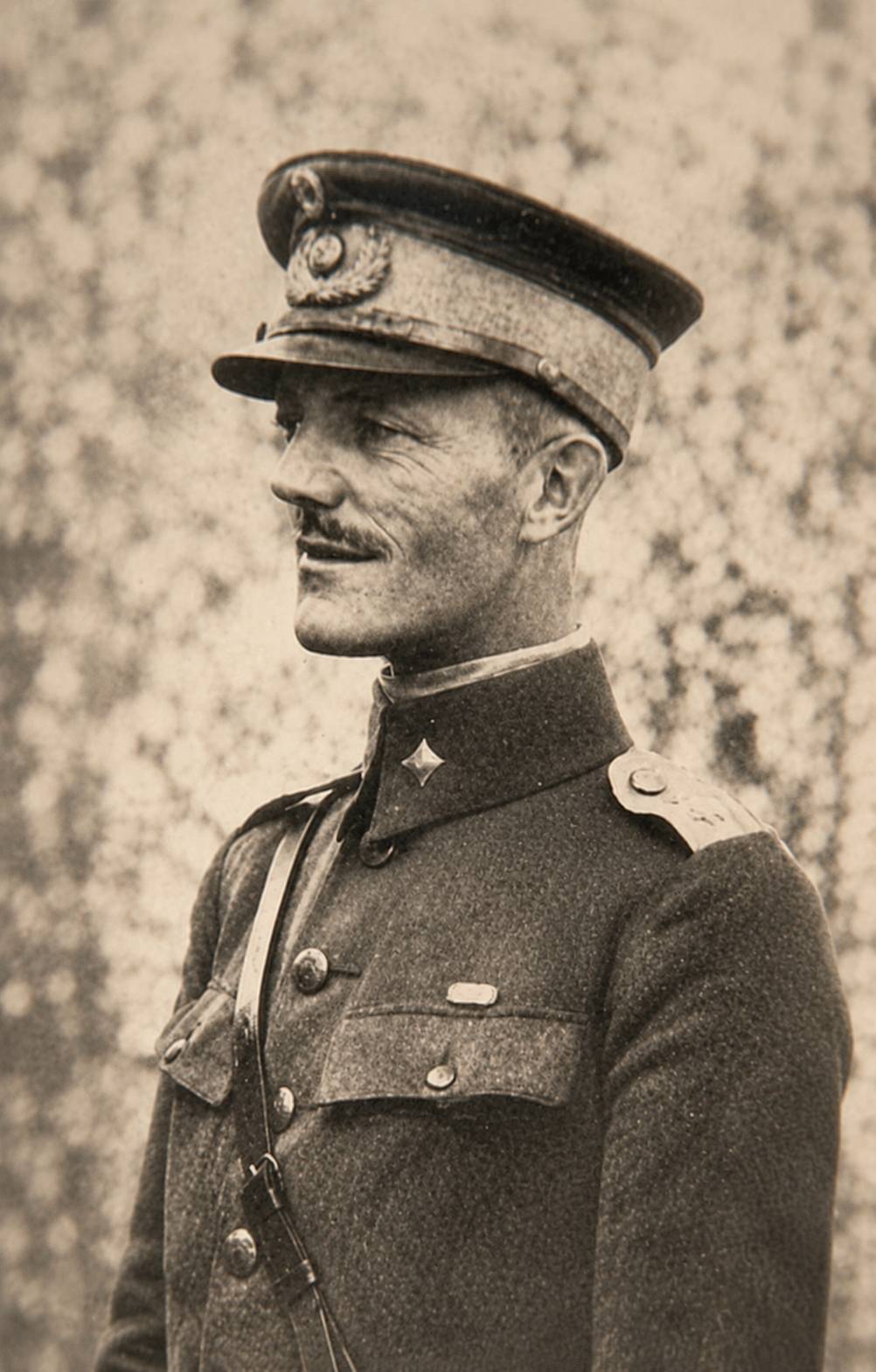
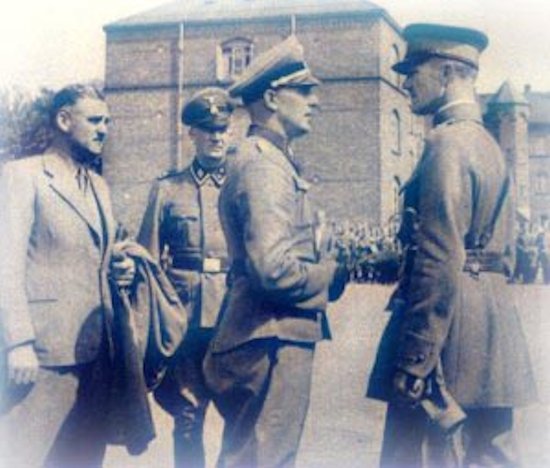
Kryssing was born on 7 July 1891 in Kolding, as the son of Captain Niels Kryssing and Christine Kjær. His father had taken part in the 1864 war at the age of 18.
In 1921, C. P. Kryssing married Karen Marie Effersøe, and they had two sons, Jens and Niels. C. P. Kryssing was the first artillery officer who, after the reunification of 1920, was posted to Southern Jutland.
From 1935 to 1937 he was attached to Haderslev Barracks, and afterwards he was promoted to lieutenant colonel and appointed commander of the artillery regiment in Holbæk, where he experienced the German occupation. 9 April was a day of disappointment for Christian Peter Kryssing.
He became lieutenant colonel, artillery officer in the 5th Artillery Regiment in Holbæk, and had 30 years of experience in the Danish army. He was the first commander of the Free Corps Denmark (29 June 1941 – 23 February 1942).
Conflicts arose in November 1941 between the conservative and monarchist C. P. Kryssing and the Nazi officers of the Free Corps. Kryssing wanted Free Corps Denmark to be a non-political regiment, while the Danish Nazi Party pushed to make the corps more explicitly National Socialist.
Kryssing was conservative but not a Nazi, which was a major contributing factor to his removal as commander of Free Corps Denmark.
On 8 February 1942, Heinrich Himmler decided that Kryssing should be dismissed as commander of the Free Corps Denmark and be replaced by Christian Frederik von Schalburg (serving with Division Wiking), who was a convinced National Socialist.
Only on 23 February 1942 was Kryssing ordered to Berlin, where he received his “dismissal notice.” Knud Børge Martinsen temporarily assumed command (23 February 1942 – 1 March 1942) until Christian Frederik von Schalburg could be released from the divisional staff of Division Wiking.
Despite Kryssing’s “dismissal notice” from the Free Corps Denmark, he continued his service in the Waffen-SS.
He was offered a position as staff officer in the artillery of the 3rd SS Division Totenkopf. Kryssing accepted, and after a short period as staff officer in the artillery of the 3rd SS Division Totenkopf, he was transferred in August 1942 to a similar position in the 5th SS Division Wiking (which at that time was operating in the Caucasus), before in 1943 being moved to corps artillery in the 3rd SS Germanic Panzer Division.
In January 1943, Kryssing was promoted to SS-Standartenführer (colonel), and in April 1943 to SS-Oberführer (brigadier general).
In August 1944, Kryssing was appointed SS-Brigadeführer (major general).
In 1944, Kryssing applied for discharge from the Waffen-SS due to personal problems, as his two sons had been killed on the Eastern Front (one serving in the Division Wiking, the other in Division Nordland), and his wife—serving voluntarily as a nurse at the hospital of the 3rd SS Germanic Panzer Division in Tallinn (Estonia)—was wounded during an air raid.
[Karen Kryssing was left disabled for the rest of her life.]
Kryssing was persuaded to withdraw his application, and he continued his service in the Waffen-SS until the end of the war, including as an artillery instructor at a Waffen-SS artillery school.
Kryssing ultimately ended his career as the highest-ranking foreigner in the Waffen-SS.
The reason for this was that Heinrich Himmler wished to demonstrate to the outside world that foreigners, too, could make a career in the Waffen-SS.
The fact that Kryssing was also one of the Waffen-SS’s best artillery officers probably did not “harm” his career. Kryssing held command of Kampfgruppe “Küste” on the Narva front (division strength), where he successfully led artillery operations against the advancing Russian forces.
In May 1945, Kryssing surrendered to the British, and in 1947 he was extradited to Denmark for prosecution.
On 27 October 1947, Kryssing was sentenced to eight years in prison, but was released after four years. After his release, he moved to his summer house at Tomaj Strand, where he received support from the German minority in the parish.
He never forgave the system and the politicians for punishing him retroactively for something he believed he had the King’s approval to do.
Kryssing died in 1976 at the age of 87. At his wife’s funeral in 1972, and also at his own in 1976, no formal ceremony was held. Both had wished to be cremated and buried in Aabenraa without the involvement of a priest.
The photos shown depict C. P. Kryssing and Thor Jørgensen in Danish officers’ uniforms and in German Waffen-SS officers’ uniforms respectively.