
Article from the German military magazine Der Freiwillige; the article was written by H. T. Nielsen.
Translation of image 1.
The Danish SS-Sturmbannführer (ret.) Oluf von Krabbe died on 30 October 1999.
It is reported that in the garden of the house there was a private burial site, possibly with a small memorial plaque, where a local resident came on several occasions to lay flowers. The small flower bed was, of course, allowed to remain, but whether it was a person or a pet that had been laid to rest there remained a mystery.
For Oluf von Krabbe, an officer’s career was therefore determined from the very beginning. In the early 1920s, he studied at the Royal Academy and acquired a certain knowledge of racial theory, although this was only truly shaped by his visit to Germany in 1937. During the following years, he became increasingly attracted to Germany and viewed it as a model of economic and social reconstruction, as well as the solution to the plight of the population.
When the war reached Denmark in April 1940 with the German annexation of the country, Captain von Krabbe was commanding the northern part of Jutland along the Danish-German border. According to his own account, he was deeply shocked that the Danish Army had surrendered only two hours after 9 April 1940, even though, due to the weather, the Wehrmacht held only a slight advantage.
As the greatest danger to Denmark was seen as the armoured units from the east and the threat of Bolshevism, he did not hesitate for a second when the King and his government announced on 29 June 1941 that active officers were now permitted to fight in the East. The Danish unit would finally be able to fight against Bolshevism.
As a result of his crusading journey to Kiev, he travelled with the first wave of around 600 men to Hamburg-Langenhorn, where Frikorps Danmark was established. At the beginning of August 1941, he joined the battalion and shortly thereafter served as Leg.-Hauptsturmführer and commander of the 3rd Company.
As no field units had been established for his position, he was to a lesser extent employed in his service while wearing the uniform of a Royal Danish captain, for example during the parade of “Frikorps Danmark” on 6 August 1941.
Leg.-Hauptsturmführer von Krabbe was detached from the Free Corps before its deployment had even begun. His path led through various schools and training programs, and later through different combat groups within the SS Motorized Infantry Brigade.
For his outstanding performance in the field and his personal bravery, he was awarded both classes of the Iron Cross.
As an SS-Sturmbannführer of the Reserve, he claimed to have assumed command of III./SS Volunteer Grenadier Regiment 67 of the 27th SS Volunteer Grenadier Division “Langemarck” (Flemish) on 1 April 1945.
Modern historians, however, generally agree with Richard Landwehr’s assessment that he was actually the commander of I./SS Volunteer Grenadier Regiment 68, a battalion of the Flemish Hitler Youth, in which members of the National-Socialistische Jeugd Vlaanderen (NSJV) served.
Because of all the dreams of a Greater Germany that von Krabbe embraced, a Danish battalion never became part of the division “Langemarck,” where, among others, his compatriot SS-Obersturmführer (later SS-Standartenführer) Roger Zetterfeldt served in the SS Volunteer Artillery Regiment, which fought the final heavy battles before the crossing of the Oder River.
Between the end of the war and the present account, von Krabbe attempted to flee to Funen and return to Denmark, but without success. He managed to evade the forces of the Danish resistance movement for a considerable time, but was eventually captured.
His path led through internment camps, courts, and prisons, and ultimately ended in Germany, but in spirit he remained unshaken. He rejected the political system in Denmark, the power of the Allies, and the idea of joining a pan-European Waffen-SS. He withdrew from public life and relied on his own strength, while being branded a traitor and a criminal.
Caption:
Hauptsturmführer Oluf von Krabbe, still wearing his Danish uniform, proudly leads his field-grey company, 3./“Frikorps Danmark,” during the parade at Hamburg-Langenhorn on 6 August 1941.
Translation of image 2.
Having been dismissed as an officer, he had lost his pension as a professional officer and was only allowed to earn his living as a civilian. As an officer, he had been accustomed to educating people, and in prison he took up this responsibility together with Ejnar Vaaben, who was responsible for the ideological training of the Germanic SS of the Schalburg Corps in Denmark.
They taught, wrote, and supported former front comrades and present fellow prisoners in various ideological matters.
In 1976, he published his first book, “Danish Soldiers in the Fight on the Eastern Front 1941–1945.” Since then, the book has been regarded as a standard work on the Danish volunteers who fought for Europe on the German side.
In 1998, he published a long-awaited revised edition of the book. In 1996, his political book “The Political Inferno” and “DoD Lodges and the 1000 Weapons” were published. The latter work was published under the pseudonym Holger Dannis.
In 1999, he published the book “Testament for Europe.”
Until his death, Oluf von Krabbe was regarded by officers as one of the most convinced believers in the cause of Denmark and Europe. To the very end, Oluf von Krabbe remained marked by his belief in a pan-European Waffen-SS, and he never mourned his mistakes or his fallen comrades.
All former Danish Eastern Front volunteers honoured this man and also lit their flame from his. Modern historians today regard these European young people as role models that are lacking today.
But as always:
His honour is called loyalty.
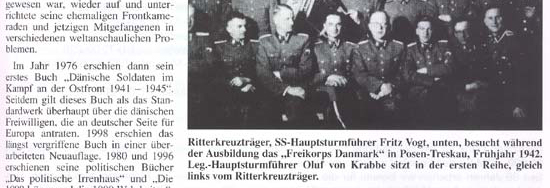
Caption:
Knight’s Cross recipient SS-Hauptsturmführer Fritz Vogt, at the bottom, visits Frikorps Danmark during its training at Posen-Treskau, spring 1942. Leg.-Hauptsturmführer Oluf von Krabbe is seated in the front row, immediately to the left of the Knight’s Cross recipient.