
Writing exercise XIV, December 1942
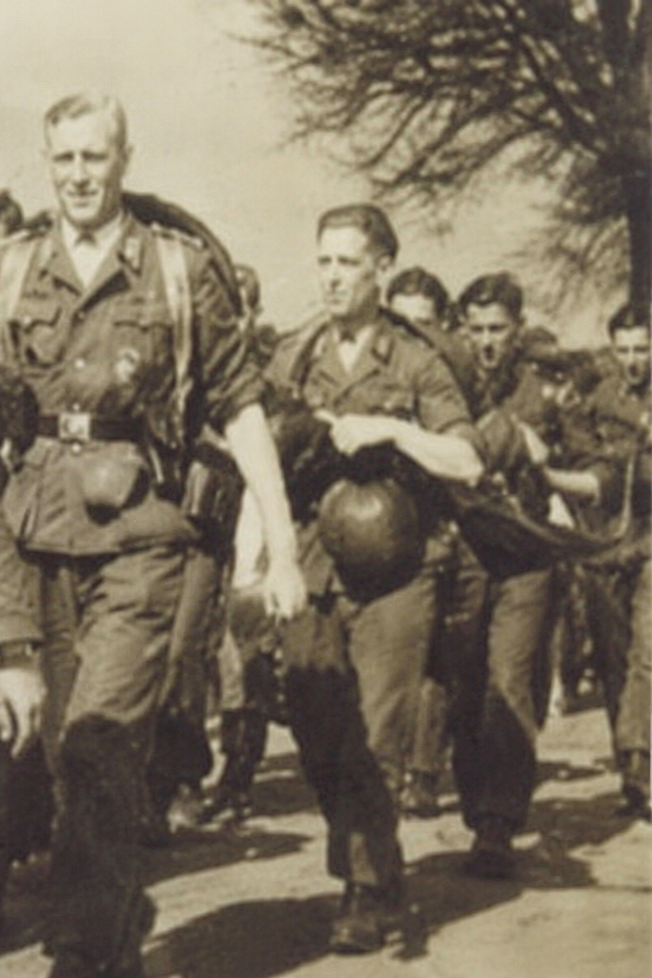
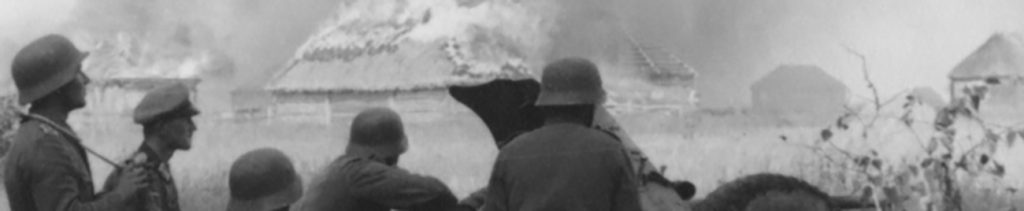
At Velikiye Luki – on bridge guard – in combat on Christmas night.
In contrast to the time at Lake Ilmen, where we stayed in the same place for a longer period, we were constantly moved around during this deployment.
The bridge guard duty, considering that the H.K.L. was only a few hundred metres outside the village, looked very little like real warfare here. Our vehicles stood openly on the village streets, and there were only a few bunkers in the settlement.
Almost all of our men lived in the houses around the area. These were not the fighting soldiers, but the support troops with their many depots, offices, kitchens, and supply rooms, and the personnel belonging to them.
We were told immediately that it was an exceptionally quiet sector. We saw very little of Ivan. Only a few days passed before we were relieved again.
But we did not return to our bunkers in the 3rd Company. In the meantime, the company had moved and was once again positioned in front of Ivan somewhere inside the U-shaped front sector.
One of our vehicles took us there. It was not very far—perhaps 10 to 15 km inside the “U.”
From the main road we turned onto a side road and drove a couple of kilometres until we stopped in a small village, where the road ended.
Considering that the H.K.L. was only a few hundred metres outside the village, it looked very little like a war zone here. Our vehicles stood freely on the village streets, and there were only a few bunkers in the village.
Almost all our men lived in the surrounding houses. However, these were not the combat soldiers, but the support troops with their many depots, offices, kitchens, supply rooms, and related personnel.
We were also told immediately that it was an exceptionally quiet sector. We saw very little of Ivan.
My group, however, belonged to the actual combat troops, and we immediately took up forward outpost positions. Here too, seen from a front soldier’s perspective, the bivouac conditions were excellent.
My group was assigned a sector that included a fine bunker. It had been cut into a hillside, with windows and a door facing the valley to our south, while Ivan was to the north. Because of this, we were completely covered by the hill inside the bunker.
The bunker’s walls and ceiling were lined with a thick layer of straw, making it extra well sealed. We had our brought-along stove set up in the men’s room.
It was small, but still contained enough sleeping space, as well as a table and chairs—very makeshift, of course.
In the few days we were here, we had good days. We only had one position to occupy, and it required only one man during the day and two at a time at night.
The position was built on the hill above the bunker, about 25 metres from ??, and was equipped with one of our machine guns. A telephone line was always connected between the position and the bunker, where the rest of the men were on standby.
Despite the overall calm, I did lose my first man here, and it happened in the middle of the day.
He was standing alone on guard as usual, while the rest of us were in the bunker having dinner. In the middle of our peaceful meal, the alarm sounded, and we rushed to our designated combat positions.
I ran to the post in the position and found him bleeding from a gunshot wound in the arm behind the machine gun.
I brought him back to the bunker and had the wound dressed. It was a relatively light injury, though the bullet had gone through the upper arm, but it was not life-threatening.
The wounded man was taken away by a medic, and we had to remain in position for a couple of hours, ready for an immediate continuation of the firing. But nothing more happened that night, nor during the following time we stayed there.
The single shot had been the work of a lone sniper.
I only stayed with my group here for a few days before we were moved again. But it was merely a reorganisation within the company. We were only moved to another position a couple of hundred metres from the old one, though in this way we came somewhat closer to the enemy.
Our sector was arranged so that our neighbour was the company’s command centre, housed in a large bunker where the commander Vorsøe Larsen and his second-in-command, Unterscharführer Poulsen, resided, together with the company runners.
It was a colder dugout we were given here, and there was considerably more night watch duty, as we were now very close to the enemy lines.
It was probably the closest we had ever been in fixed positions, as there were no more than a hundred metres to Ivan’s forward posts. Only a deep, narrow ravine lay between the two opposing lines.
Our positions, however, were well developed, with deep dugouts and trenches that provided excellent protection. But Ivan was even better off, as directly in front of us (only a few hundred metres away) stood a church high on the edge of the ravine.
Its thick walls and tall dome gave Ivan both solid cover and a good observation point. From the dome it was possible to observe everything happening far behind our forward lines, which was very uncomfortable and could also become quite dangerous.
That church bothered us quite a bit.
At night we had a listening post far forward, just in front of our positions, placed behind a small tree. It was quite exciting to stand there on a quiet night, listening to the many different sounds that could be heard in the darkness.
Writing exercise XV
The day had slowly begun to break.
The first thing we did after posting the guards was to find the two Danes who, since before midnight, had been in involuntary company with Ivan. We found them in a bunker that was securely sealed, but which was quickly opened when the occupants heard Danish voices outside.
Two pale-faced men opened up; they had had a terrible night, during which one had remained at the telephone the entire time, directing our artillery fire down onto their own heads, until the connection had been cut just before we stormed in.
The other had been busy blocking up every opening through which a Russian grenade might be thrown.
All night they had been prepared for the possibility that each minute could be their last in this world, but they were also determined to sell their lives as dearly as possible, and they had a stock of all kinds of weapons in the bunker.
However, Ivan’s focus on fighting at the H.K.L. had likely saved their lives until we arrived.
At the same time as the last Russians disappeared, we had re-established contact with our comrades and managed to stop the insane fire they had been laying down on us.
It came as a complete surprise to the rest of the corps that the town had suddenly been back in our hands. Not a single person, apart from the 17 of us, had had the slightest idea of what we were doing.
On the morning of Christmas Day 1942, Poulsen again appeared in his open greatcoat and stood on a pile of ruins in the middle of the town, calmly declaring it occupied by us.
Not only that—it was to be held against any possible counterattacks.
The day proved no less eventful than the night. As soon as the sun spread its light over the wild swamp terrain, we were completely cut off from the outside world, as the strongpoint (the town) was surrounded on all sides by flat, open terrain entirely dominated by enemy weapons.
A house standing somewhat apart from the town was also found to contain a Dane. He was a pioneer. He immediately established contact with us, but otherwise remained alone throughout Christmas Day behind a machine gun, which he used frequently against a steadily pressing enemy.
We were still only our 17 men and had no chance of receiving any reinforcements as long as daylight lasted. One had to occupy the positions around the town and hold out— or die. There was no way back.
My now somewhat reduced group occupied the entire southern side of the town. But there was no such thing as off-duty time; everyone was on post at the same time.
As group leader, I could not walk around like a little general either, but lay alone behind a heavy machine gun that 1st Company had left behind, complete with belts of many thousands of rounds. Or I fired one of 1st Company’s heavy mortars, as if I had done nothing else in my life, even though I had never handled such a weapon before.
All this took place while I simultaneously directed the fighting within the group’s wide sector. And fighting it was, throughout the entire day, with full force.
Ivan wanted the town back and had during the night withdrawn just outside it into a valley covered from our weapons by a hill. Early in the morning they launched their first attack on our positions with vastly superior forces, supported by infantry guns.
But our men’s fighting spirit was at its highest; we fought like devils that day. We had been strengthened by the results of the night, and there was something almost strange about it.
Thus this deployment was over for my part (which of course I could not have known at the time), and I never returned to the front again.
The medic sent me back on a stretcher to another village further to the rear, where the medical station was located not far away.
There I lay for a day in the company’s office and with the quartermaster. Here too there were many offices, depots, and workshops—a whole small administrative town behind the H.K.L.
A town that every day sent out a large number of vehicles in all directions, collecting and delivering all the many things required by a fighting force at the front.
It had to be a well-organised system if everything was to function despite the many difficulties that such a primitive life at the front presented.